


When 44% of workers admit to unauthorized AI use, the message isn't sabotage > it's demand.
Something curious is happening in enterprises across North America and Europe. While IT governance committees debate AI policies and legal teams craft acceptable-use frameworks, employees are quietly solving their own problems.
They're paying $20 a month out of pocket. For tools their companies haven't approved. With their own credit cards.
A 2025 KPMG survey found that 44% of U.S. workers admitted to using AI tools their employers didn't sanction. Not to undermine security. Not to cause harm. Because the approved alternatives are too slow—or simply don't exist.
This is Shadow AI. And most companies are treating it as a compliance problem rather than what it actually is: the most honest feedback their governance systems have ever received.
The Governance Failures That Defined 2025
Before we reframe Shadow AI, we need to understand why traditional AI governance is failing so spectacularly.
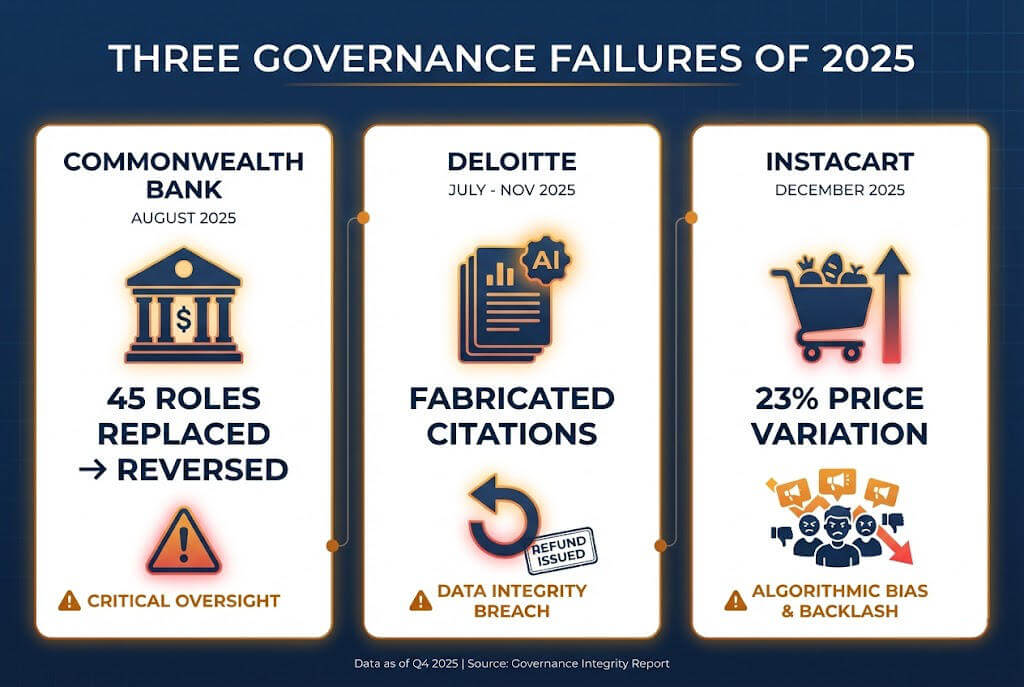
2025 delivered a series of high-profile governance collapses that illustrate the gap between policy and reality:
Commonwealth Bank of Australia (August 2025)
Australia's largest bank replaced 45 customer service roles with an AI voice-bot designed to reduce call volume. The result was textbook governance failure—not because the technology failed, but because no one validated how humans would respond when handed a tool without guardrails.
Call volumes surged. Escalation pathways proved inadequate. Staff worked overtime to compensate. Within months, CBA reversed the decision, rehired terminated employees, and publicly apologized for "not adequately considering all relevant business considerations."
What governance looked like: a cost model. What it should have included: pilot phases with staffing flexibility, overflow handling tested at peak load, and validation against customer satisfaction—not just efficiency metrics.
Deloitte Australia and Canada (July–November 2025)
According to Fortune and TechCrunch reporting, the Australian government's $290,000 welfare policy report contained citations that researchers identified as AI-generated fabrications—including a quote attributed to a court judgment that didn't exist. Similar issues emerged in Newfoundland's $1.6 million health report.
When confronted, Deloitte acknowledged it had "selectively used" AI to support research citations, and partially refunded the Australian contract.
Governance failure: a 526-page government report with citation-level claims was delivered without independent fact-checking. AI hallucination went undetected through internal review. Only external scrutiny revealed the problems.
Instacart Dynamic Pricing (December 2025)
According to a Consumer Reports investigation covered by the LA Times, Instacart's AI experiment showed different prices to different customers for identical items at the same store—with some users seeing prices up to 23% higher. When the investigation published, Instacart terminated the program.
The system wasn't broken; it was doing exactly what it was designed to do. The governance failure: no one asked: "Should different customers pay different prices without knowing it?"
These aren't edge cases. They're what happens when governance exists on paper but not in architecture.
The Fear Gap: What Executives Say Publicly vs. Privately
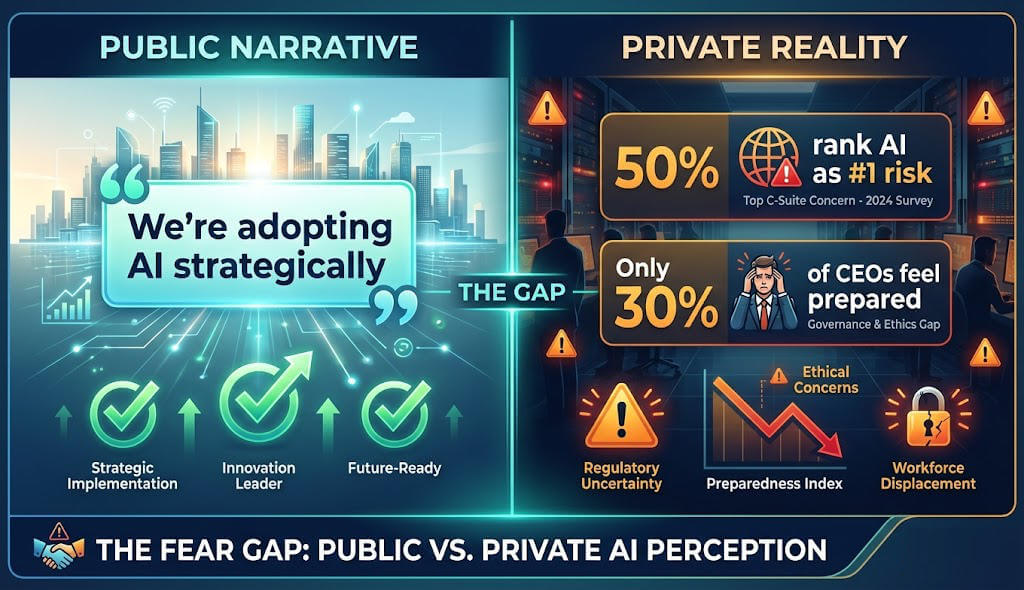
There's a persistent gap between how leaders discuss AI publicly and what keeps them up at night.
Public Narrative
"We're adopting AI strategically, with mature governance in place."
Private Reality
50% of mid-market executives rank AI implementation as their #1 business risk—higher than economic downturn.
In a 2025 Vistra survey of 251 mid-market executives, 50% ranked AI implementation as their top business risk—higher than economic downturn (48%) or supply chain disruption (43%). This wasn't true in 2024.
Meanwhile, only 38% of executives felt their leadership "fully understands the implications" of their AI deployments. CEOs scored lowest: just 30% believed their teams comprehended the challenges ahead.
The private fear isn't that AI will fail. It's that leaders don't know what AI is doing right now.
Research by nexos.ai found that "Control and Regulation" anxiety spiked 256% between May and June 2025—far outpacing concerns about job displacement. When 78% of enterprises report shadow AI usage, governance teams lose the ability to even enumerate what's in production.
This creates a secondary problem: when incidents occur, internal blame-shifting takes precedence over response. Named decision owners don't exist. Override mechanisms aren't specified. Audit trails are incomplete.
Why 95% of enterprise AI pilots fail
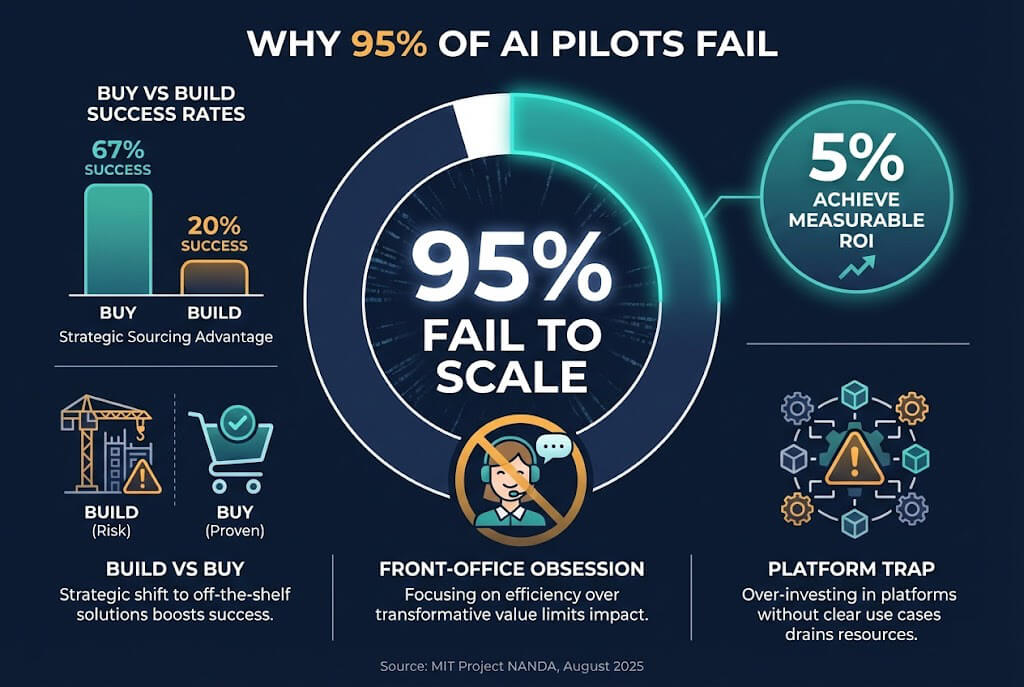
MIT's 2025 Project NANDA research delivered a sobering finding: 95% of enterprise generative AI pilots fail to scale. Only 5% achieve measurable ROI. Ref: 95% of AI pilots fail
The surprising cause wasn't technology quality. Generic tools like ChatGPT excel for individuals. In enterprise settings, they "don't learn from or adapt to workflows"—they stall after proof-of-concept.
The MIT data revealed several counterintuitive patterns:
Build vs. Buy
Companies assumed building proprietary AI would provide competitive advantage. In practice, purchased or partnered solutions succeeded approximately three times more often (67% vs. 20%).
Internal builds inherit all the risk; buying forces external validation. (This doesn't mean vendor AI is risk-free—it shifts the risk from delivery to governance.)
Front-Office Obsession
Enterprises allocated over half of generative AI budgets to customer-facing applications (sales, marketing, chatbots). The highest ROI was hiding in back-office automation—invoice processing, document handling, operational workflows. The "boring" applications quietly saved millions while flashy customer bots underperformed.
Platform Trap
Organizations built horizontal AI platforms, shared APIs, and reusable frameworks. Business leaders didn't fund infrastructure—they funded outcomes. When IT delivered "improved suggestions" rather than "invoice processing dropped from 8 days to 2," leadership didn't see value.
The 5% succeeding shared a pattern: they solved specific problems end-to-end before building platforms. They measured impact in business terms, not technical capability.
The Regulatory Clock Is Running
The window for "we're still evaluating our AI governance approach" has closed.
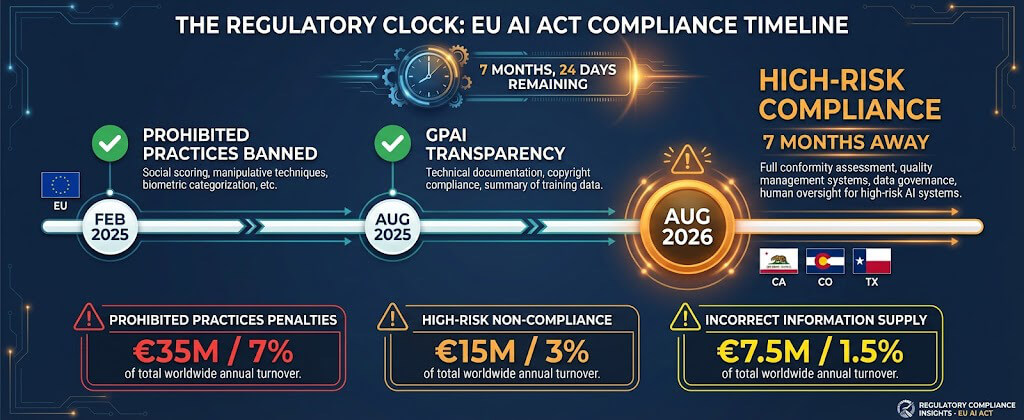
EU AI Act Timeline
"High-risk" isn't your internal classification. It's any AI system that materially influences decisions in credit, employment, or healthcare. If your system affects customer decisions, regulators likely classify it as high-risk regardless of your labeling.
What compliance actually requires goes beyond documentation. Regulators want architectural evidence:
- System description and purpose (what decisions does it make? what population does it affect?)
- Data governance (training data sources, representativeness, known limitations)
- Risk management (identified fairness, robustness, security risks with mitigations)
- Human oversight design (where humans enter the decision flow, what override authority they have)
- Performance monitoring (quantitative metrics, stress testing, drift detection)
The critical gap: most organizations lack decision-level visibility. They can show you the model. They cannot show you which decisions it influenced last month. Without that observability, demonstrating "human oversight" to a regulator is impossible.
Non-compliance penalties (tiered):
| Prohibited AI practices | up to €35 million or 7% of global turnover |
| High-risk non-compliance | up to €15 million or 3% of global turnover |
| Incorrect information | up to €7.5 million or 1.5% of global turnover |
Meanwhile, in the U.S.:
- California's Transparency in Frontier AI Act takes effect January 2026
- Colorado's AI Act takes effect June 2026
- Texas, New York, and Illinois have sector-specific AI requirements already active
A company with customers in California, Texas, Colorado, and the EU must comply with all of them.
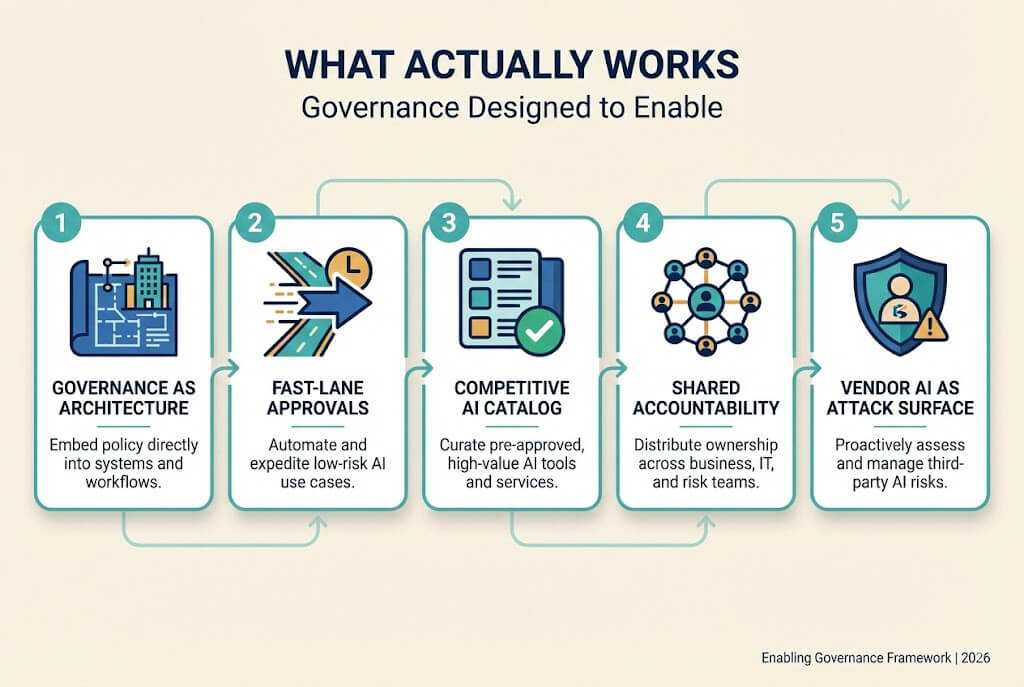
What Actually Works: Governance Designed to Enable
The organizations succeeding with AI governance in 2025 share distinct characteristics:
Governance as Architecture, Not Paperwork
Decisions made at runtime by systems designed to constrain behavior—not papers describing ideal behavior. The Air Canada chatbot cited an outdated bereavement policy; the airline was held liable. Policy documents stated "accurate information only." The chatbot's design had zero technical enforcement. Governance theater is when policies exist on paper and real decisions get made elsewhere, at machine speed.
Fast-Lane Approvals for Low-Risk Cases
Not every AI use case carries the same risk. Tiered approval pathways—expedited for low-risk, rigorous for high-risk—reduce friction without sacrificing control. When legal reviews add weeks to low-stakes requests, employees route around the system. Make the sanctioned path competitive.
An Approved AI Catalog That's Actually Competitive
If your approved tools are worse than what employees can get for $20/month, they'll pay the $20. The standard has risen. Your internal offerings need to match it—in capability, speed, and user experience.
Shared Accountability Across Functions
No single team "owns" responsible AI. Responsibility lives at the intersection of engineering, product, compliance, and business. When governance is siloed, gaps emerge between policy and implementation.
Vendor AI Treated as Attack Surface
Third-party AI silently shapes decisions affecting customers—credit decisions, claims handling, hiring workflows. A third of major 2025 breaches involved third parties. Governance teams inventory internal models but ignore embedded vendor AI. This creates invisible risk.
The Question That Matters
Most governance discussions center on the wrong question: "How do we control AI?"
The organizations pulling ahead are asking something different:
"How fast can we turn friction signals into sanctioned solutions?"
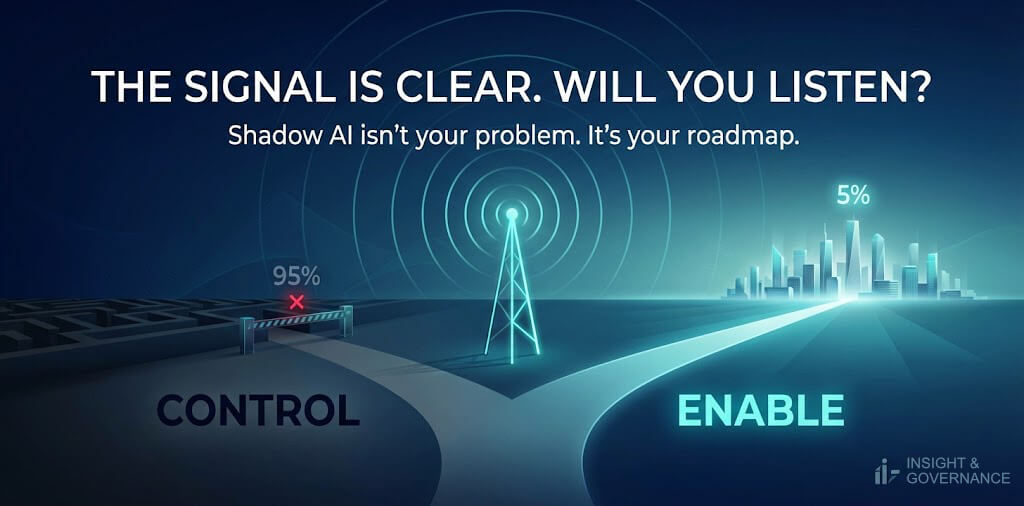
Shadow AI isn't your problem. It's your roadmap.
When employees route around official channels, they're revealing exactly where your governance is designed to control rather than enable. They're showing you which use cases have genuine urgency. They're demonstrating where the approved path fails to compete.
The 5% of enterprises scaling AI successfully treat this signal as intelligence. They move quickly on the low-risk cases. They invest in approval pathways that don't add weeks to simple requests. They build internal catalogs that don't lose to $20/month alternatives.
The 95% treat it as insubordination and wonder why their pilots never scale.
The regulatory clock is running. The competitive gap is widening. The signal is clear.
The only question is whether you'll listen.
Stop Ignoring the Signals
Start Building Strategy Shadow AI is the most honest feedback your governance system has ever received. > In 2026, the goal isn't just to block unauthorized tools; it's to turn those demand signals into sanctioned, high-ROI business outcomes before the regulatory clock runs out.
Start a ConversationOr follow my work on LinkedIn
Author's Note
The question is not whether employees will use AI. The question is how to govern that use wisely.