
I’m an enterprise AI leader i Canada focused on orchestrating value through institutionalized governance and adoption. I standardize how AI is evaluated, deployed, and measured so organizations realize material cost improvements, revenue impact, and reliability gains-with responsible guardrails. I lead portfolio-level adoption (AIOps/MLOps, LLMOps, observability, evaluation gates, human-in-the-loop) and embed repeatable frameworks. My background spans telecom/media and enterprise technology across multi-shore delivery, with an emphasis on scaling value beyond one-off pilots.
Architecting the Sentient Enterprise
Enterprise AI Strategy
Consciousness Research
De-risking the transition to Agentic AI while preserving the human element.

Advising Enterprise AI Leaders | Vendor Agnostic Perspectives
How I Help
I partner with enterprise leaders navigating the shift from experimental AI to operational intelligence – building the governance frameworks, adoption strategies, and measurement systems that turn pilots into lasting business value.
AI Strategy & Governance
Define enterprise AI vision, establish responsible guardrails, and create evaluation frameworks that de-risk adoption while accelerating value delivery.
Agentic Systems Architecture
Architect autonomous AI systems with human-in-the-loop oversight; moving beyond chatbots to agents that reason, plan, and execute.
Decision Intelligence
Transform data into strategic action. Build measurement systems that connect AI investments to revenue impact, cost reduction, and competitive advantage.
Consciousness & Frontier AI
Explore the boundaries of machine intelligence - from neural interfaces to consciousness research. Preparing organizations for what's next, not just what's now.
Philosophy Becoming Engineering
The next decade of AI won’t be won by those with the best algorithms; it will be won by those who understand what intelligence actually is, and how to deploy it responsibly at scale..
Frontier Thinking
For a decade, I've explored the boundaries of machine cognition; not as academic exercise, but to understand what's coming and how to prepare for it.
Enterprise Rigor
AI without governance is liability. I build the frameworks, evaluation gates, and "human in the loop" systems that let enterprises move fast without breaking trust.
The Bridge
Most advisors speak either corporate or technical. I translate between boardrooms and research labs turning philosophical questions into engineering roadmaps.
“I don’t predict the future of AI. I help organizations architect their role in it.”
INSIGHTS

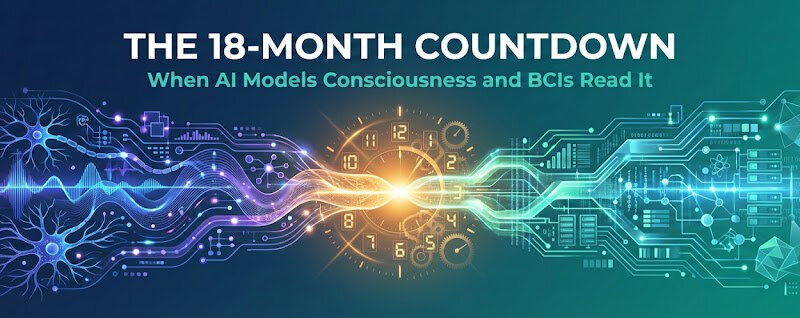
18-Month Countdown – convergence of BCI and AI consciousness
When AI models consciousness and BCIs read it, who owns the signal in between?
This is not a philosophical musing. It is a governance question that will land on enterprise risk registers within eighteen months.
The countdown is not about whether BCIs will read consciousness. They already can, to a degree. Neuralink has implanted approximately twenty patients who log thousands of hours controlling devices with thought alone. Synchron’s Stentrode reads motor intent from within blood vessels without open-brain surgery. The hardware vector is accelerating.
Nor is the countdown about whether AI will model consciousness. Anthropic now employs dedicated researchers investigating whether frontier models warrant moral consideration. DeepMind has posted openings for consciousness researchers. The software vector is maturing.
The countdown is about convergence: what happens when these two vectors meet. When an AI system can interpret what a BCI reads, and neither law, ethics, nor enterprise governance has a framework to contain the implications.
For leaders in enterprise AI, healthcare technology, or frontier research, this is not a 2030 problem. It is a 2026 board-level risk.
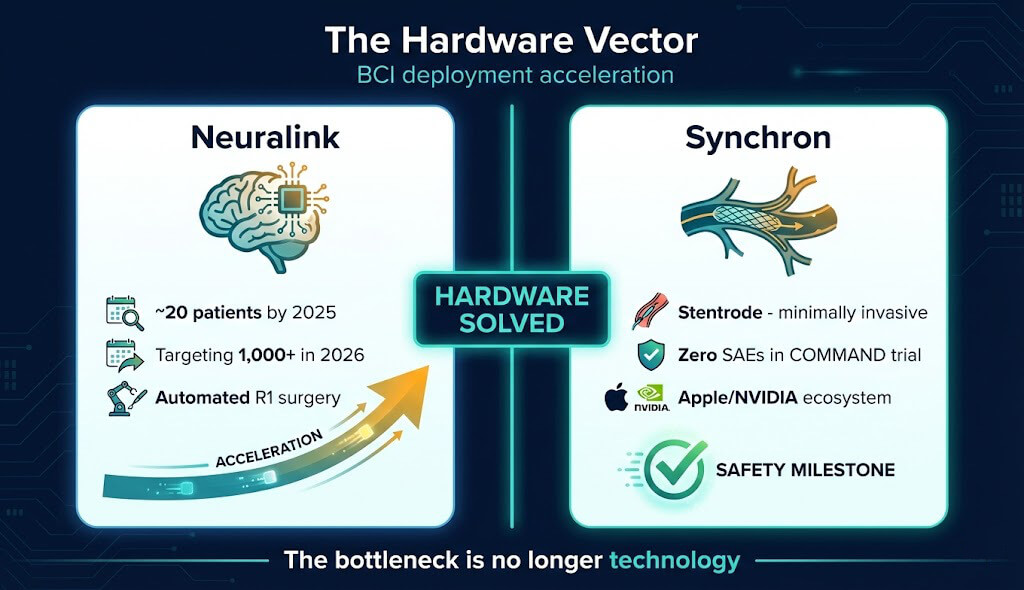
Part I: The Hardware Vector – BCI Deployment Acceleration
Neuralink’s Industrial Pivot
December 2025 marked a strategic inflection. Neuralink announced a shift from clinical research to industrial production. By year-end, the company had implanted approximately twenty patients globally across sites in the United States, Canada, and the United Arab Emirates. The stated goal for 2026: “high-volume production” with “near-fully automated surgical procedures.”
This is not incremental progress. It represents a fundamental change in what constrains BCI adoption. The bottleneck is no longer technology. It is neurosurgical capacity. Neuralink’s R1 surgical robot, capable of implanting electrode threads with precision no human can match, removes that constraint.
Neuralink Trajectory
- ~20 patients implanted by late 2025
- 15,000+ cumulative hours of device use (PRIME trial)
- Targeting “thousands annually” by 2027
- Speech restoration and robotic arm control trials expected Q1-Q2 2026
Synchron’s Alternative Approach
Synchron has achieved something Neuralink has not: a safety profile that makes commercialization plausible within the 2026-2027 window.
The company’s COMMAND trial met its primary endpoint in 2024 with zero device-related serious adverse events resulting in death or permanent disability over twelve months. The Stentrode device, delivered through the jugular vein rather than via craniotomy, avoids the risks of open-brain surgery entirely.
Synchron Advantages
- Minimally invasive (endovascular approach)
- Uses existing catheterization lab infrastructure
- Apple and NVIDIA ecosystem partnerships
- Shorter path to broad deployment
Conservative projections suggest thousands of BCIs implanted by end of 2026. The question of “whether BCIs work” has been answered. The remaining questions are about scale, access, and what we do with the data they generate.
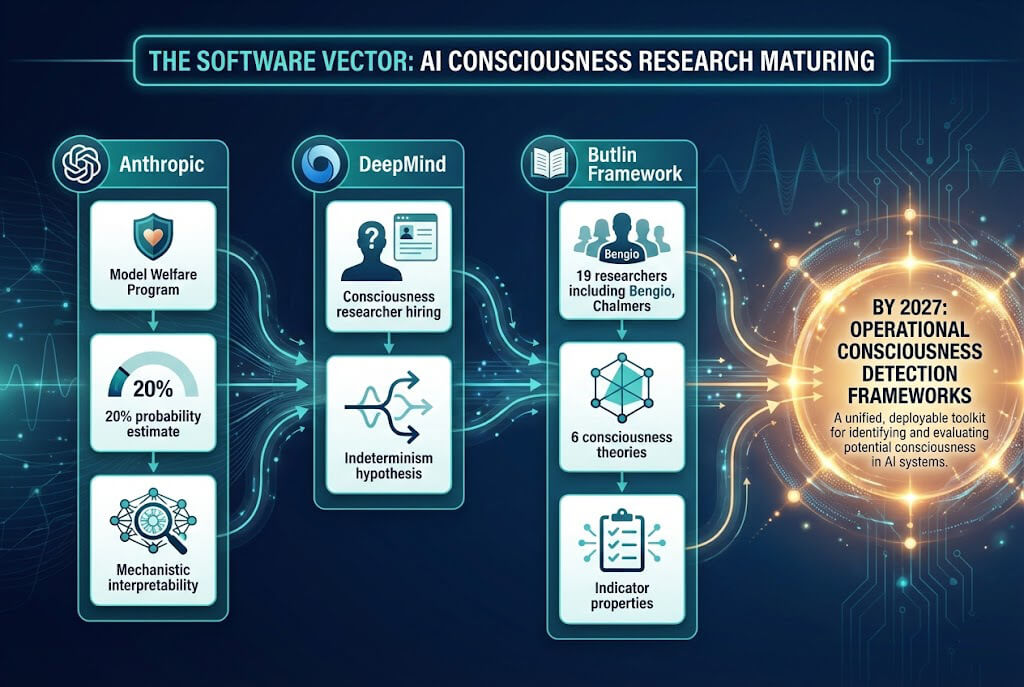
Part II: The Software Vector – AI Consciousness Research Matures
Anthropic’s Model Welfare Program
In September 2025, Anthropic formally expanded its “model welfare” research program, hiring researchers to investigate whether AI systems could develop consciousness and warrant moral consideration.
This is not fringe speculation. Kyle Fish and colleagues are building on mechanistic interpretability research: tools designed to decode neural-like activations into human-comprehensible concepts. The work has demonstrated that specific concepts reliably activate distinct regions within frontier models.
An Anthropic researcher has estimated a twenty percent probability that “somewhere in some part of the process, there’s at least a glimmer of conscious or sentient experience” in frontier AI systems.
The Consciousness Assessment Framework
In 2023, a consortium of nineteen neuroscientists, philosophers, and AI researchers published a framework for assessing consciousness in AI. The group included Turing Award winner Yoshua Bengio and philosopher David Chalmers.
They derived indicator properties from six leading neuroscientific theories:
- Recurrent Processing Theory: Consciousness involves feedback loops
- Global Workspace Theory: Specialized modules integrate through a bottleneck
- Higher-Order Theories: The system must be aware of its own mental states
- Predictive Processing: The system models its environment through prediction error
- Attention Schema Theory: The system constructs a model of its own attention
Large Brain Models: The Convergence Technology
The most significant development for BCI-AI integration is the emergence of Large Brain Models.
Researchers have successfully adapted the Transformer architecture to interpret EEG and neural data. The technique uses “neural tokenizers” that convert continuous neural signals into discrete codes, similar to how text is tokenized for language models.
We now have tools that translate the “language of the brain” into formats that AI can manipulate with fluency.
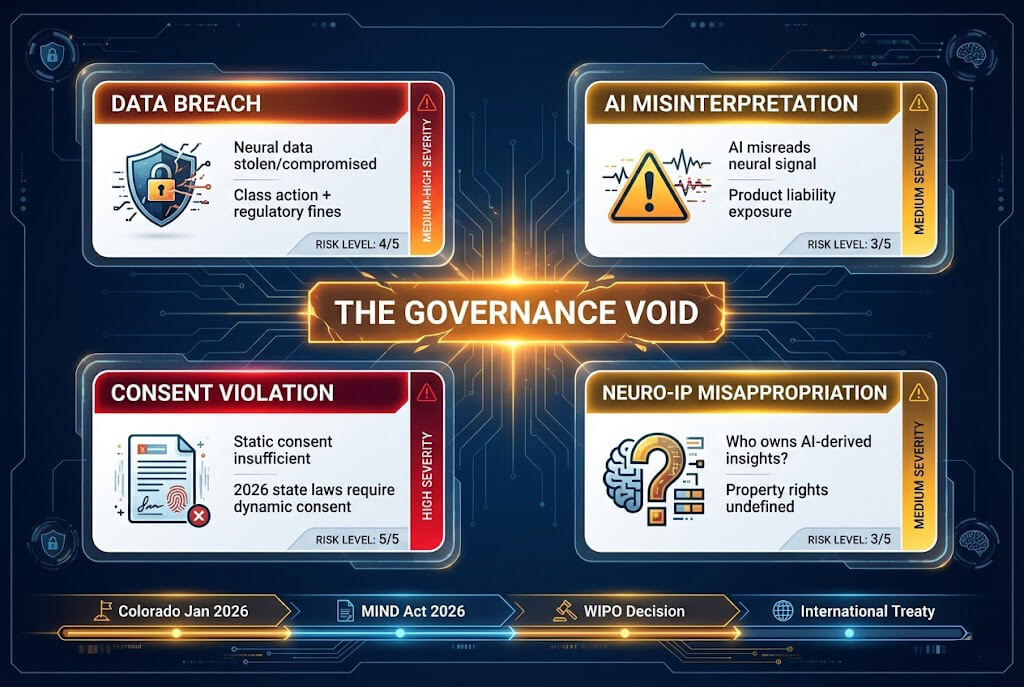
Part III: The Convergence Risk – Where Governance Breaks
The Property Rights Void
Current law assumes neural data belongs to the individual whose brain produced it. This assumption breaks under scrutiny.
When an AI system processes neural data and discovers a correlation, who owns that discovery? The patient who generated the raw signal? The company whose infrastructure captured it? The researchers whose algorithms found the pattern?
The Unmapped Scenario
- A BCI company collects neural data from 10,000 users to optimize device function
- The company’s AI discovers that neural pattern X predicts risk-taking behavior
- This insight is packaged and licensed to a financial services firm for hiring traders
- Candidates are evaluated using neural-based predictions without knowing the source
Which laws apply? The original users consented to “device optimization.” The derived insight serves a different purpose. This is unmapped territory.
Write Access: The Deeper Risk
Most regulatory attention focuses on read-out BCIs: devices that decode thoughts. Write-in BCIs pose distinct challenges.
If an AI system can stimulate neural tissue to produce a desired emotional state or decision, it fundamentally alters autonomy. This is not science fiction. Neuralink’s Blindsight project, which received FDA Breakthrough Device Designation in 2025, involves sensory encoding: writing data into the brain rather than reading it out.
Read-Out BCIs
Privacy risks
Thought surveillance, data breach
Write-In BCIs
Identity risks
Thought manipulation, autonomy alteration
AI Processing of Neural Data: The Regulatory Gap
The EU AI Act regulates AI systems. GDPR regulates data. The intersection—AI processing of sensitive neural data—is underspecified.
Current frameworks assume human review of data handling. They do not account for AI systems that can:
- Extract patterns the original data controller didn’t know were present
- Repurpose neural data for applications the patient never consented to
- Generate synthetic neural data that evades anonymization protections
Part IV: The Four-Gate Governance Framework
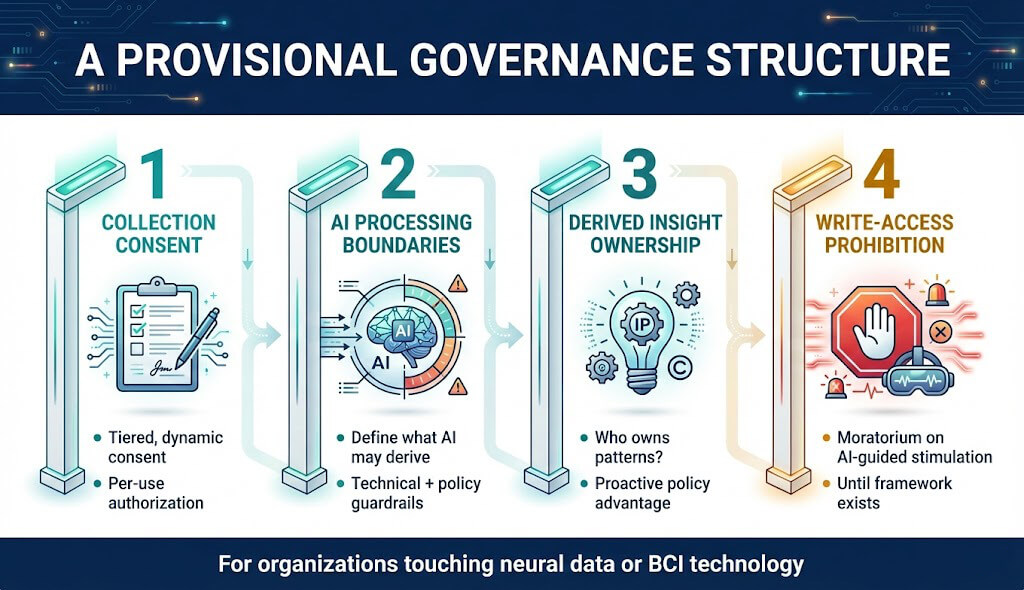
For organizations touching neural data or BCI technology, a provisional governance structure:
1
Collection Consent Architecture
Static consent models are becoming obsolete. Colorado and California now require tiered, dynamic consent with separate authorization per use and third-party share. Organizations should assume this standard will spread.
2
AI Processing Boundaries
Define explicit limitations on what AI systems may derive from neural data. If consent covers “device optimization,” AI training on that data for personality prediction exceeds scope. Build technical and policy guardrails before regulators mandate them.
3
Derived Insight Ownership
Establish clear policies for who owns patterns discovered in neural data. The patient, the company, or a shared model? This question has no settled legal answer. Organizations that answer it proactively will have competitive advantage when regulation clarifies.
4
Write-Access Prohibition Until Framework Exists
For organizations not engaged in clinical trials with explicit write-in protocols, establish a moratorium on any BCI application that involves neural stimulation guided by AI interpretation. The liability exposure is undefined. The ethical terrain is unmapped. Wait.
Part V: The Philosophical Dimension – What BCIs Cannot Answer
There is a deeper question beneath the governance concerns.
The Hard Problem of consciousness asks why physical processes give rise to subjective experience at all. David Chalmers formulated it in 1995. It remains unsolved.
BCIs can read neural correlates. They can detect which brain states accompany which subjective reports. But correlation is not explanation. A perfect neural readout of someone experiencing the color red tells us nothing about why there is “something it is like” to see red.
BCIs will transform how we interact with technology. They will generate unprecedented data about the brain. They will not, by themselves, answer what consciousness is.
The organizations that understand this distinction—that resist overclaiming what their technology reveals—will maintain intellectual credibility as the field matures.
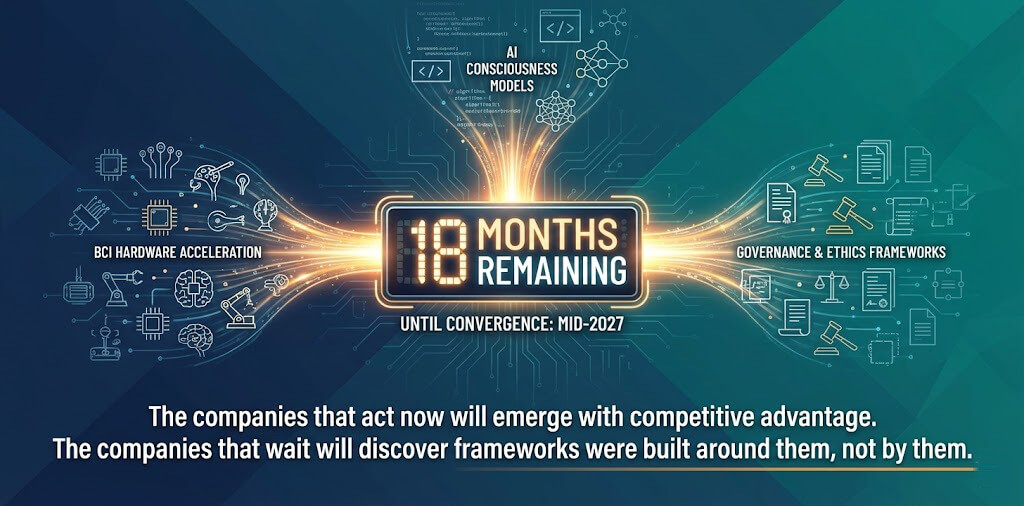
Conclusion: The 18-Month Window
By mid-2027:
- Hardware: Neuralink will have scaled to thousands of implants. Synchron may have achieved commercial approval. Automated surgery will be operational.
- Software: Anthropic, DeepMind, and OpenAI will have consciousness detection frameworks deployed on frontier models.
- Governance: Colorado, California, and Minnesota neural data laws will be in force. The MIND Act may have created federal framework.
- Reality: AI systems will be reading neural data, extracting insights, and potentially guiding behavior through stimulation—all without clear property rights, consent models, or liability frameworks.
This is not speculation. Each element has a documented trajectory.
The question is not whether this convergence will occur. It is whether organizations will treat it as a board-level governance priority or a compliance checkbox.
The companies that act now will emerge from this window with reduced liability exposure, stakeholder trust, and competitive advantage.
The companies that wait will discover that the legal and ethical frameworks were built around them, not by them.
The countdown has begun.
Sources
- Neuralink high-volume production announcement – ME Observer, January 2026
- Synchron COMMAND trial results – Clinical Trials Arena, September 2024
- Anthropic Model Welfare expansion – Observer, September 2025
- Butlin et al. consciousness assessment framework – arXiv, 2023
- Colorado HB24-1058 – Neural data as sensitive personal information, 2024
- MIND Act analysis – CSIS, DWT, 2025
- Chile neurorights constitutional protection – UNESCO Courier, 2021
- Neuralink PRIME trial data – Reuters, Neurapod, 2025
This article was written with research assistance from Multiple Frontier LLM’s. All claims have been verified against primary sources.
Start the Governance Conversation
The convergence arrives mid-2027. The planning window is now. Whether you’re evaluating neural data policies, building AI processing boundaries, or aligning governance frameworks—the board-level conversation should start before the frameworks are built around you, not after.
Or follow my work on LinkedIn
Author’s Note
This article was written in collaboration with AI, reflecting the very convergence it explores: human strategic judgment meeting machine capability at the frontier of consciousness research. The synthesis of Neuralink deployment data, Anthropic’s model welfare program, regulatory timelines, and governance frameworks all benefited from AI assistance.
This collaboration does not diminish the human elements of judgment, experience, and philosophical perspective. It amplifies them. Just as organizations must evaluate how AI will process neural data, AI writing assistance transforms analytical capacity through computational partnership—raising the same questions of boundaries, consent, and derived insight that the article examines.
The question is not whether these technologies will converge. The question is whether we’re building the governance frameworks now, or discovering them later.
Follow me on LinkedIn for regular insights on bridging enterprise AI governance with frontier research in consciousness and neurotechnology.


Vera Rubin: The Infrastructure Question Worth Asking
TL;DR
- NVIDIA’s Vera Rubin architecture offers up to 10x inference cost reduction vs. Blackwell for large-scale AI workloads (Source: NVIDIA CES 2026 keynote)
- This changes the build vs. cloud calculus for agentic AI systems
- Q1 2026 action required: Budget conversations, vendor evaluations, governance alignment
- Headwinds: Power constraints (120kW+ for leading-edge racks), 18-24 month procurement cycles, EU AI Act compliance (August 2026)
The Announcement
At CES 2026, NVIDIA announced their next-generation AI computing platform: Vera Rubin.
The headline claim: NVIDIA projects up to 10x inference cost reduction compared to Blackwell architecture, under optimal conditions. Independent benchmarks are awaited.
If validated, this shifts infrastructure economics significantly. But the implications require careful analysis, not hype.
What NVIDIA Is Projecting
According to NVIDIA’s official announcement:
- Inference cost reduction: Up to 10x per token (projected, optimal conditions)
- Training efficiency: 1/4 the GPUs required for mixture-of-experts models
- Production timeline: Full manufacturing ramp H2 2026
- Early access: Via CoreWeave, Lambda, Nebius, and Nscale
These are vendor projections. As with any major platform shift, real-world enterprise performance will vary based on workload characteristics, integration complexity, and operational factors.
The Build-vs-Cloud Question Evolves
The question is not “on-prem vs cloud.” That framing oversimplifies.
Consider:
1. Cloud providers benefit too
AWS, Azure, and GCP will receive Vera Rubin allocations. Some may pass efficiency gains to customers through pricing or performance improvements. Your cloud provider’s GPU roadmap matters.
2. Data residency remains a factor
For regulated industries, on-device processing (as showcased by Lenovo’s Qira announcement) offers compliance advantages that persist regardless of cost per token.
3. Infrastructure investment is non-trivial
Leading-edge AI racks now draw 120kW+ per rack, requiring liquid cooling infrastructure. This is not a procurement decision; it is a facility decision.
4. The analysis window is opening
H2 2026 hardware ramp means planning conversations should begin in H1 2026, not after chips ship.
Governance Complexity Is Rising
Infrastructure economics are only part of the equation.
Per official EU regulatory timeline, the EU AI Act reaches full enforcement for high-risk AI systems in August 2026. Compliance frameworks are now operational requirements, not optional enhancements.
Additionally, ISO 42001 certification is emerging as a consideration for enterprise AI procurement. Companies like Liferay and CM.com have announced compliance. This may not yet be a hard requirement, but procurement teams are beginning to ask.
The implication: Infrastructure decisions now intersect with governance decisions. Cost per token is one variable; regulatory readiness is another.
The Planning Conversation
This is not a “buy now” signal. Hardware ships H2 2026.
But for organizations with significant AI inference workloads, the planning conversation may warrant starting now:
Questions for your infrastructure team:
- At what inference volume does the economics shift materially?
- What is our primary cloud provider’s GPU roadmap for 2026-2027?
- What facility investments would on-prem require?
Questions for your finance team:
- How are we modeling AI infrastructure spend for 2027 budget planning?
- What assumptions are we making about cloud pricing trends?
Questions for your governance team:
- Are we tracking EU AI Act compliance requirements?
- Is ISO 42001 on our procurement checklist?
What This Is Not
This is NOT
- A recommendation to immediately shift from cloud to on-prem
- A claim that cloud AI is “obsolete”
- A guarantee that NVIDIA’s projections will hold at enterprise scale
This IS
- A signal that infrastructure economics may be entering a new phase
- A prompt to begin planning conversations before hardware ships
- A reminder that governance complexity is rising alongside compute capability
Summary
NVIDIA’s Vera Rubin announcement suggests a potential shift in AI infrastructure economics. Vendor projections of up to 10x inference cost reduction (under optimal conditions) warrant attention, but await independent validation.
The build-vs-cloud analysis is evolving, not reversing. Cloud providers also benefit from new architectures. Data residency, governance requirements, and facility investments all factor in.
For organizations with material AI inference spend, the planning window has opened. H2 2026 hardware availability means H1 2026 analysis.
The question is not “should we switch?”
The question is “what assumptions are we making, and when should we revisit them?”
FAQ
What is NVIDIA Vera Rubin?
Vera Rubin (named after the astronomer) is NVIDIA’s next-generation AI computing architecture announced at CES 2026, succeeding Blackwell. It offers significantly improved inference economics and is designed for “AI factory” deployments handling agentic workloads.
When will Vera Rubin be available?
Full production ramp is scheduled for H2 2026. Early access will be through cloud providers. Most enterprise deployments will realistically occur in 2027.
What does “10x cost reduction” mean in practice?
This refers to cost-per-token for inference workloads on Vera Rubin vs. Blackwell architecture. The improvement is most significant for high-volume agentic AI systems. Organizations should model their specific workloads rather than assume universal applicability.
What is ISO 42001?
ISO 42001 is the International Standard for AI Management Systems, establishing a framework for responsible AI governance. It is emerging as a consideration for enterprise AI deployments, similar to how SOC 2 became standard for cloud services.
What is the EU AI Act and why does it matter for infrastructure decisions?
The EU AI Act is comprehensive AI regulation with high-risk system requirements taking effect August 2026. Organizations deploying AI infrastructure that falls under these requirements need governance and compliance frameworks in place before deployment, making governance a Q1 2026 planning consideration rather than a post-deployment activity.
Sources
- NVIDIA CES 2026 keynote (Jensen Huang presentation)
- TomHardware: “Nvidia launches Vera Rubin NVL72 AI supercomputer”
- CIO Dive: “Nvidia’s Rubin platform aims to cut AI training, inference costs”
- EU AI Act enforcement timeline (August 2026)
- ISO 42001 certification announcements (Liferay, CM.com)
Start the Planning Conversation
The hardware ships H2 2026. The analysis window is now. Whether you’re evaluating cloud provider roadmaps, modeling infrastructure spend, or aligning governance frameworks > the planning conversation should start before the chips arrive, not after.
Or follow my work on LinkedIn
Author’s Note
This article was written in collaboration with AI, reflecting the very theme it explores: the practical reality of human strategic judgment meeting machine capability in an enterprise context. The synthesis of NVIDIA announcements, regulatory timelines, and infrastructure economics all benefited from AI assistance.
This collaboration does not diminish the human elements of judgment, experience, and strategic perspective. It amplifies them. Just as organizations are evaluating how AI can transform their infrastructure economics, AI writing assistance transforms analytical capacity through computational partnership.
The question is not whether to adopt new technology. The question is what assumptions we’re making, and when to revisit them.
Follow me on LinkedIn for regular insights on bridging enterprise pragmatism with frontier research in AI strategy.
Dave Senavirathne advises companies on strategic AI integration. His work bridges enterprise pragmatism with frontier research in consciousness and neurotechnology.

Shadow AI: The Governance Signal You’re Ignoring
When 44% of workers admit to unauthorized AI use, the message isn’t sabotage > it’s demand.
Something curious is happening in enterprises across North America and Europe. While IT governance committees debate AI policies and legal teams craft acceptable-use frameworks, employees are quietly solving their own problems.
They’re paying $20 a month out of pocket. For tools their companies haven’t approved. With their own credit cards.
A 2025 KPMG survey found that 44% of U.S. workers admitted to using AI tools their employers didn’t sanction. Not to undermine security. Not to cause harm. Because the approved alternatives are too slow—or simply don’t exist.
This is Shadow AI. And most companies are treating it as a compliance problem rather than what it actually is: the most honest feedback their governance systems have ever received.
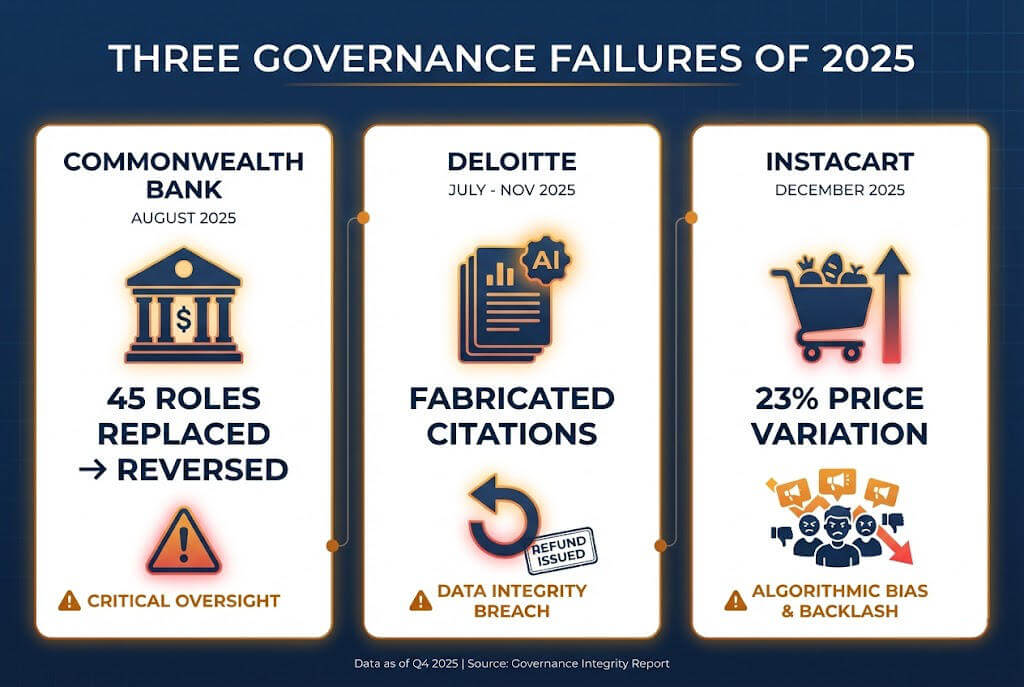
The Governance Failures That Defined 2025
Before we reframe Shadow AI, we need to understand why traditional AI governance is failing so spectacularly.
2025 delivered a series of high-profile governance collapses that illustrate the gap between policy and reality:
Commonwealth Bank of Australia (August 2025)
Australia’s largest bank replaced 45 customer service roles with an AI voice-bot designed to reduce call volume. The result was textbook governance failure—not because the technology failed, but because no one validated how humans would respond when handed a tool without guardrails.
Call volumes surged. Escalation pathways proved inadequate. Staff worked overtime to compensate. Within months, CBA reversed the decision, rehired terminated employees, and publicly apologized for “not adequately considering all relevant business considerations.”
What governance looked like: a cost model. What it should have included: pilot phases with staffing flexibility, overflow handling tested at peak load, and validation against customer satisfaction—not just efficiency metrics.
Deloitte Australia and Canada (July–November 2025)
According to Fortune and TechCrunch reporting, the Australian government’s $290,000 welfare policy report contained citations that researchers identified as AI-generated fabrications—including a quote attributed to a court judgment that didn’t exist. Similar issues emerged in Newfoundland’s $1.6 million health report.
When confronted, Deloitte acknowledged it had “selectively used” AI to support research citations, and partially refunded the Australian contract.
Governance failure: a 526-page government report with citation-level claims was delivered without independent fact-checking. AI hallucination went undetected through internal review. Only external scrutiny revealed the problems.
Instacart Dynamic Pricing (December 2025)
According to a Consumer Reports investigation covered by the LA Times, Instacart’s AI experiment showed different prices to different customers for identical items at the same store—with some users seeing prices up to 23% higher. When the investigation published, Instacart terminated the program.
The system wasn’t broken; it was doing exactly what it was designed to do. The governance failure: no one asked: “Should different customers pay different prices without knowing it?”
These aren’t edge cases. They’re what happens when governance exists on paper but not in architecture.
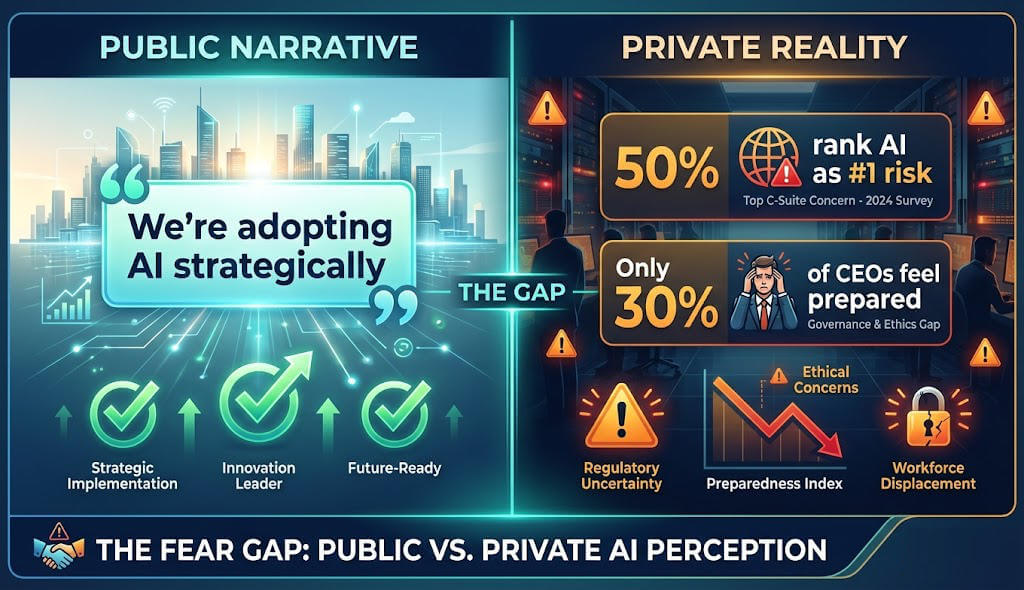
The Fear Gap: What Executives Say Publicly vs. Privately
There’s a persistent gap between how leaders discuss AI publicly and what keeps them up at night.
Public Narrative
“We’re adopting AI strategically, with mature governance in place.”
Private Reality
50% of mid-market executives rank AI implementation as their #1 business risk—higher than economic downturn.
In a 2025 Vistra survey of 251 mid-market executives, 50% ranked AI implementation as their top business risk—higher than economic downturn (48%) or supply chain disruption (43%). This wasn’t true in 2024.
Meanwhile, only 38% of executives felt their leadership “fully understands the implications” of their AI deployments. CEOs scored lowest: just 30% believed their teams comprehended the challenges ahead.
The private fear isn’t that AI will fail. It’s that leaders don’t know what AI is doing right now.
Research by nexos.ai found that “Control and Regulation” anxiety spiked 256% between May and June 2025—far outpacing concerns about job displacement. When 78% of enterprises report shadow AI usage, governance teams lose the ability to even enumerate what’s in production.
This creates a secondary problem: when incidents occur, internal blame-shifting takes precedence over response. Named decision owners don’t exist. Override mechanisms aren’t specified. Audit trails are incomplete.
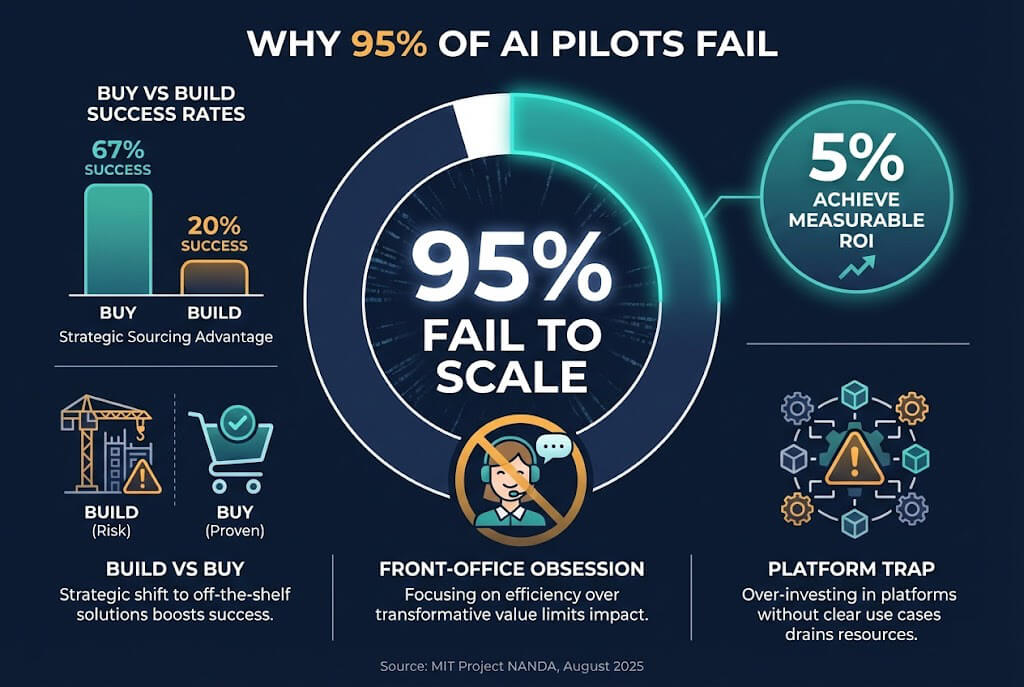
Why 95% of enterprise AI pilots fail
MIT’s 2025 Project NANDA research delivered a sobering finding: 95% of enterprise generative AI pilots fail to scale. Only 5% achieve measurable ROI. Ref: 95% of AI pilots fail
The surprising cause wasn’t technology quality. Generic tools like ChatGPT excel for individuals. In enterprise settings, they “don’t learn from or adapt to workflows”—they stall after proof-of-concept.
The MIT data revealed several counterintuitive patterns:
Build vs. Buy
Companies assumed building proprietary AI would provide competitive advantage. In practice, purchased or partnered solutions succeeded approximately three times more often (67% vs. 20%).
Internal builds inherit all the risk; buying forces external validation. (This doesn’t mean vendor AI is risk-free—it shifts the risk from delivery to governance.)
Front-Office Obsession
Enterprises allocated over half of generative AI budgets to customer-facing applications (sales, marketing, chatbots). The highest ROI was hiding in back-office automation—invoice processing, document handling, operational workflows. The “boring” applications quietly saved millions while flashy customer bots underperformed.
Platform Trap
Organizations built horizontal AI platforms, shared APIs, and reusable frameworks. Business leaders didn’t fund infrastructure—they funded outcomes. When IT delivered “improved suggestions” rather than “invoice processing dropped from 8 days to 2,” leadership didn’t see value.
The 5% succeeding shared a pattern: they solved specific problems end-to-end before building platforms. They measured impact in business terms, not technical capability.
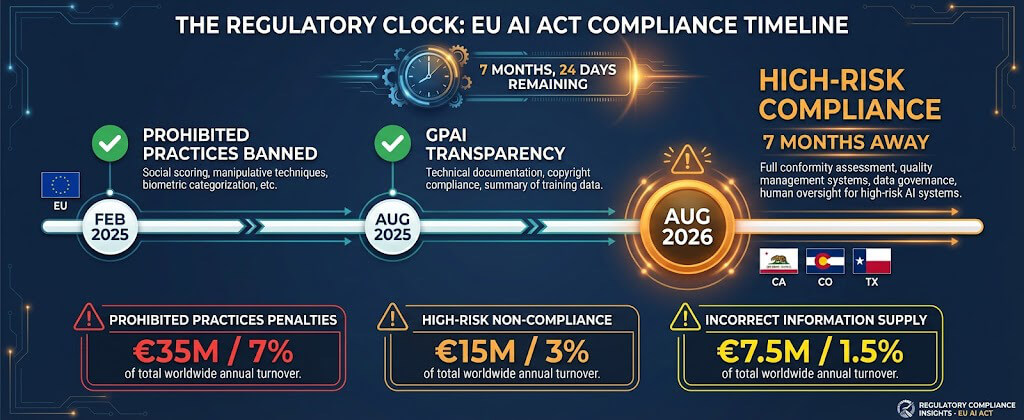
The Regulatory Clock Is Running
The window for “we’re still evaluating our AI governance approach” has closed.
EU AI Act Timeline
Feb 2025
Prohibited practices
✓ Passed
Aug 2025
GPAI transparency
✓ Passed
Aug 2026
HIGH-RISK COMPLIANCE
7 MONTHS AWAY
“High-risk” isn’t your internal classification. It’s any AI system that materially influences decisions in credit, employment, or healthcare. If your system affects customer decisions, regulators likely classify it as high-risk regardless of your labeling.
What compliance actually requires goes beyond documentation. Regulators want architectural evidence:
- System description and purpose (what decisions does it make? what population does it affect?)
- Data governance (training data sources, representativeness, known limitations)
- Risk management (identified fairness, robustness, security risks with mitigations)
- Human oversight design (where humans enter the decision flow, what override authority they have)
- Performance monitoring (quantitative metrics, stress testing, drift detection)
The critical gap: most organizations lack decision-level visibility. They can show you the model. They cannot show you which decisions it influenced last month. Without that observability, demonstrating “human oversight” to a regulator is impossible.
Non-compliance penalties (tiered):
| Prohibited AI practices | up to €35 million or 7% of global turnover |
| High-risk non-compliance | up to €15 million or 3% of global turnover |
| Incorrect information | up to €7.5 million or 1.5% of global turnover |
Meanwhile, in the U.S.:
- California’s Transparency in Frontier AI Act takes effect January 2026
- Colorado’s AI Act takes effect June 2026
- Texas, New York, and Illinois have sector-specific AI requirements already active
A company with customers in California, Texas, Colorado, and the EU must comply with all of them.
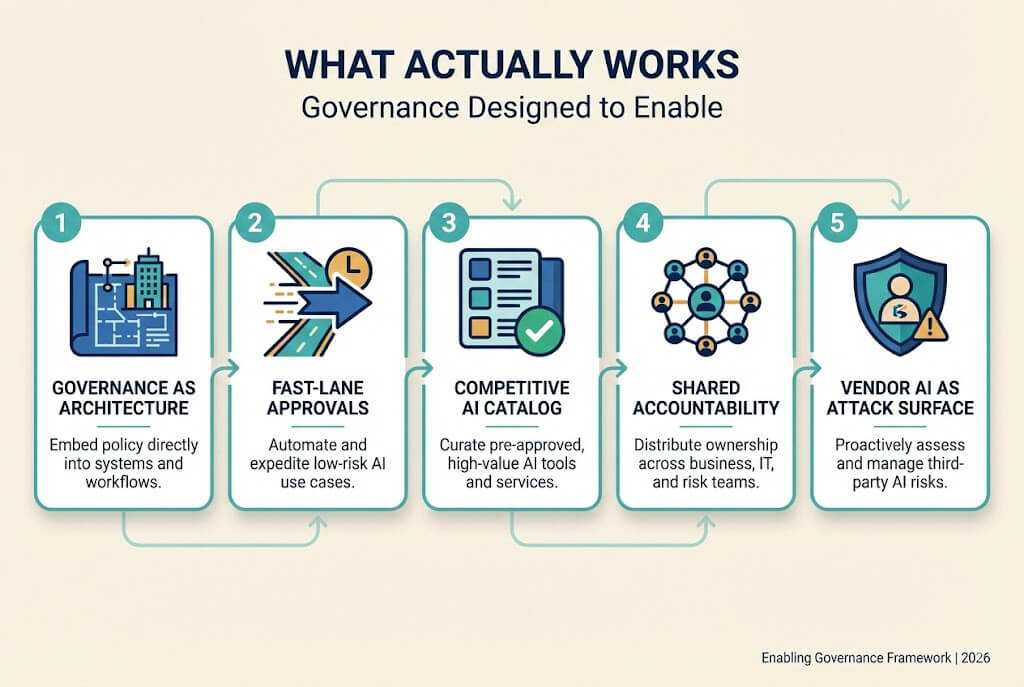
What Actually Works: Governance Designed to Enable
The organizations succeeding with AI governance in 2025 share distinct characteristics:
1
Governance as Architecture, Not Paperwork
Decisions made at runtime by systems designed to constrain behavior—not papers describing ideal behavior. The Air Canada chatbot cited an outdated bereavement policy; the airline was held liable. Policy documents stated “accurate information only.” The chatbot’s design had zero technical enforcement. Governance theater is when policies exist on paper and real decisions get made elsewhere, at machine speed.
2
Fast-Lane Approvals for Low-Risk Cases
Not every AI use case carries the same risk. Tiered approval pathways—expedited for low-risk, rigorous for high-risk—reduce friction without sacrificing control. When legal reviews add weeks to low-stakes requests, employees route around the system. Make the sanctioned path competitive.
3
An Approved AI Catalog That’s Actually Competitive
If your approved tools are worse than what employees can get for $20/month, they’ll pay the $20. The standard has risen. Your internal offerings need to match it—in capability, speed, and user experience.
4
Shared Accountability Across Functions
No single team “owns” responsible AI. Responsibility lives at the intersection of engineering, product, compliance, and business. When governance is siloed, gaps emerge between policy and implementation.
5
Vendor AI Treated as Attack Surface
Third-party AI silently shapes decisions affecting customers—credit decisions, claims handling, hiring workflows. A third of major 2025 breaches involved third parties. Governance teams inventory internal models but ignore embedded vendor AI. This creates invisible risk.
The Question That Matters
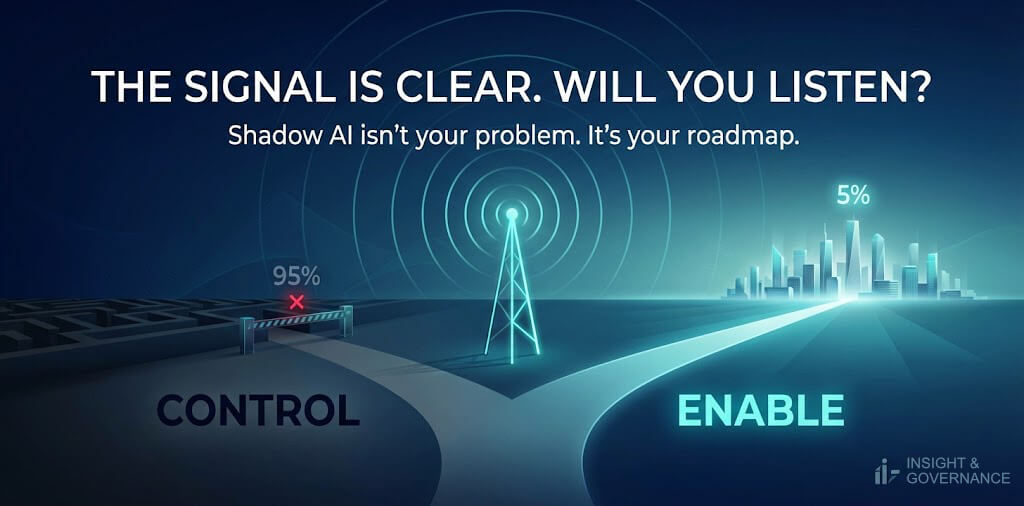
Most governance discussions center on the wrong question: “How do we control AI?”
The organizations pulling ahead are asking something different:
“How fast can we turn friction signals into sanctioned solutions?”
Shadow AI isn’t your problem. It’s your roadmap.
When employees route around official channels, they’re revealing exactly where your governance is designed to control rather than enable. They’re showing you which use cases have genuine urgency. They’re demonstrating where the approved path fails to compete.
The 5% of enterprises scaling AI successfully treat this signal as intelligence. They move quickly on the low-risk cases. They invest in approval pathways that don’t add weeks to simple requests. They build internal catalogs that don’t lose to $20/month alternatives.
The 95% treat it as insubordination and wonder why their pilots never scale.
The regulatory clock is running. The competitive gap is widening. The signal is clear.
The only question is whether you’ll listen.
Stop Ignoring the Signals
Start Building Strategy
Shadow AI is the most honest feedback your governance system has ever received. > In 2026, the goal isn’t just to block unauthorized tools; it’s to turn those demand signals into sanctioned, high-ROI business outcomes before the regulatory clock runs out.
Or follow my work on LinkedIn
Author’s Note
This article was written in collaboration with AI, reflecting the very theme it explores: the practical reality of human intention meeting machine capability in a business setting. The synthesis of governance reports, market surveys, and case studies across multiple sources all benefited from AI assistance. This collaboration does not diminish the human elements of judgment, experience, and strategic perspective. It amplifies them. Just as the 44% of workers using Shadow AI seek to amplify their own daily productivity, AI writing assistance amplifies human thought through computational partnership.
The question is not whether employees will use AI. The question is how to govern that use wisely. Follow me on LinkedIn for regular insights on bridging enterprise pragmatism with frontier research in AI strategy. Dave Senavirathne advises companies on strategic AI integration. His work bridges enterprise pragmatism with frontier research in consciousness and neurotechnology.