


Executive Summary: The 5 Insights That Matter
Before diving deep, here is what enterprise leaders and frontier researchers need to understand about the brain-computer interface revolution unfolding in 2025-2026:
| # | Insight | Why It Matters |
|---|---|---|
| 1 | The bandwidth barrier is falling. Neuralink achieved 9.51 bits per second in late 2025. Paradromics demonstrated 200+ bps information transfer rates. We are witnessing a 10x improvement in neural data throughput within 18 months. | Speed determines utility. When typing via thought becomes faster than thumbs, adoption curves steepen dramatically. |
| 2 | Non-invasive is catching up. Synchron's Stentrode requires no open brain surgery. Precision Neuroscience earned FDA 510(k) clearance. The choice between "skull drilling" and "blood vessel threading" changes the risk calculus entirely. | Enterprise applications require lower risk tolerance. Non-invasive approaches open corporate wellness, productivity, and accessibility markets. |
| 3 | Neurorights are becoming law. Chile established constitutional neurorights in 2021. Colorado and California enacted neural data protection in 2024. The EU AI Act now covers "neurodata" as sensitive personal information. | Regulatory frameworks are forming before mass adoption. Companies building BCI strategies need governance architectures now, not later. |
| 4 | Signal processing transformed overnight. The shift from Kalman filters to transformer-based decoders and LLM integration represents the real breakthrough. Hardware matters less than the AI interpreting the signals. | This is where AI expertise becomes critical. The BCI race is increasingly an AI race. |
| 5 | Investment signals conviction. Neurotech funding jumped from $662M (2022) to $2.3B (2024) to $4B+ projected for 2025. The smart money is not waiting for regulatory clarity. | Capital flows precede market formation. Enterprise leaders who dismiss BCI as "science fiction" are misreading the investment thesis. |
Introduction: When Philosophy Meets Engineering
There is a moment in every technological revolution when abstract possibility becomes concrete capability. We are living through that moment for brain-computer interfaces.
For decades, the question “Can machines read minds?” belonged to philosophy departments and science fiction writers. Today, Noland Arbaugh controls his computer cursor with thoughts alone. A paralyzed woman in the Netherlands walks again using neural signals routed to her spinal cord. Synchron patients send text messages without moving a muscle.
The questions have shifted. Not “if” but “when.” Not “can we” but “should we.” Not “is it possible” but “who governs it.”
This article synthesizes the current state of BCI technology, the companies reshaping the landscape, and the strategic implications for enterprise leaders who recognize that the next interface revolution will not be touchscreens or voice. It will be thought itself.
Part I: The Technology Landscape
The Major Players and Their Approaches
The BCI industry has consolidated around five primary architectures, each representing different tradeoffs between invasiveness, bandwidth, and scalability.
Invasive Implants (Highest Bandwidth)
Neuralink‘s N1 implant represents the current high-water mark for neural interface capability. The device contains 1,024 electrodes distributed across 64 ultra-thin threads, each thinner than a human hair. Implanted by a custom surgical robot (R1), the system has demonstrated:
– 9.51 bits per second cursor control (December 2025)
– Successful operation in 12 patients as of September 2025
– A second-generation device (Blindsight) targeting vision restoration
– Plans to reach 100 patients in 2026
The tradeoff is obvious: brain surgery. Even with robotic precision and same-day discharge protocols, the psychological and regulatory barriers remain substantial.
Semi-Invasive / Endovascular (Middle Ground)
Synchron’s Stentrode takes a radically different approach. Rather than drilling through the skull, the device is threaded through blood vessels to rest against the motor cortex. The procedure resembles a cardiac stent implantation, using familiar interventional radiology techniques.
Results from the COMMAND trial (May 2024):
– 6+ patients implanted with 100% safety record
– Hands-free device control for ALS patients
– Average time to full system use: 86 days
– No serious adverse events reported
The bandwidth is lower than direct cortical implants, but the risk profile appeals to a broader patient population and, critically, to enterprise applications.
Surface-Level / Minimally Invasive
Precision Neuroscience’s Layer 7 Cortical Interface earned FDA 510(k) clearance in June 2024, a regulatory milestone. The device sits on the brain surface rather than penetrating tissue, reducing long-term scarring risks while maintaining reasonable signal quality.
Blackrock Neurotech’s Utah Array remains the gold standard for research applications, with devices functioning for over 9 years in some patients. Their MoveAgain system targets home use for paralysis patients.
Non-Invasive (Highest Accessibility)
Companies like Emotiv, Neurable, and Kernel are pushing EEG-based approaches toward commercial viability. While bandwidth remains limited (typically under 1 bps for practical applications), these systems require no medical procedures and can be deployed at scale.
Emotiv’s MN8 earbuds, marketed for “cognitive performance monitoring,” represent the enterprise edge case: tracking attention, stress, and fatigue without any implantation.
The Bandwidth Race: Why Speed Matter
| System | ITR (bits/second) | Equivalent Capability |
|---|---|---|
| Typical EEG | 0.5-1.0 bps | Simple yes/no selections |
| Synchron Stentrode | 2-3 bps | Basic device control |
| Neuralink N1 (2024) | 6.7 bps | Cursor control, simple gaming |
| Neuralink N1 (2025) | 9.51 bps | Fast cursor, basic typing |
| Paradromics (target) | 200+ bps | Approaching natural speech rates |
| Human speech | ~39-50 bps | Full linguistic expression |
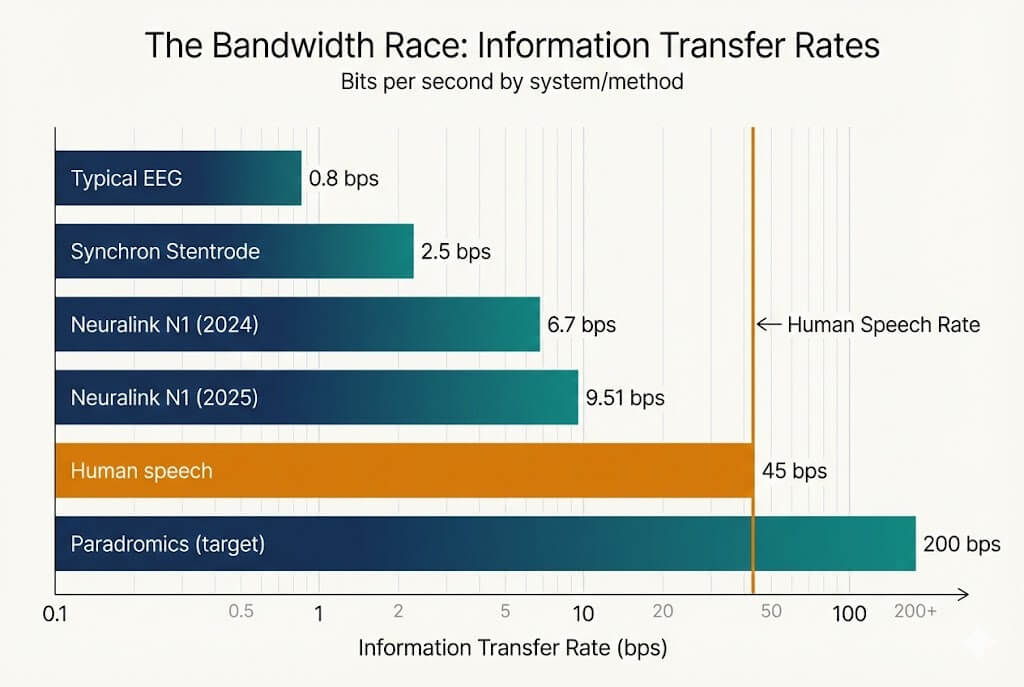
Paradromics, less visible than Neuralink but technically formidable, claims their Connexus Direct Data Interface can achieve 200+ bps using micro-electrode arrays with over 1,600 cortical contacts. If validated at scale, this would cross the threshold where thought-to-text becomes faster than typing.
The Signal Processing Revolution
The hardware gets the headlines. The AI does the work.
Early BCI systems relied on Kalman filters and linear discriminant analysis, techniques from the 1960s. The patient had to consciously “imagine” movements, and the decoder would pattern-match against limited templates.
Modern systems have transformed this approach:
Transformer Architectures: The same attention mechanisms powering ChatGPT now decode neural signals. Transformers excel at capturing temporal dependencies in sequential data, exactly what neural spike trains represent.
LLM Integration: Neuralink’s “brain-to-text” demonstrations use language models to predict intended words from partial neural signals. The decoder does not need to capture every neural spike if GPT-4 can infer the missing context.
Continuous Learning: Systems now adapt to individual neural patterns over time, improving accuracy without surgical revision. The user and the algorithm co-evolve.
Multi-Modal Fusion: Combining neural signals with eye tracking, EMG, and other inputs creates redundancy and error correction. The brain is not the only data source, just the highest-bandwidth one.
This shift explains why AI companies are suddenly interested in BCI. The bottleneck is no longer the electrodes. It is the intelligence interpreting the signals.
Part II: The Regulatory and Ethical Landscape
Neurorights: A Legal Framework Emerges
Chile made history in 2021 by becoming the first nation to enshrine neurorights in its constitution. The framework protects:
– Mental privacy (thoughts cannot be accessed without consent)
– Personal identity (neural modifications cannot alter core selfhood)
– Free will (neural interfaces cannot override autonomous decision-making)
– Equitable access (neurotechnology cannot create cognitive classes)
This was not theoretical posturing. In 2023, Chile’s consumer protection agency ruled against Emotiv for collecting neural data without adequate disclosure. The company was required to modify its practices and compensate affected users.
The ripple effects are spreading:
United States: Colorado (2024) enacted neural data protection under consumer privacy law. California followed with similar provisions. Neither state went as far as constitutional neurorights, but the direction is clear.
European Union: The AI Act explicitly covers “neurodata” as a special category requiring enhanced protection. Systems that process neural information face the strictest compliance requirements.
Spain: Active consideration of comprehensive neurorights legislation modeled on the Chilean framework.
For enterprise leaders, the implication is straightforward: neural data governance is not a future concern. It is a present requirement in multiple jurisdictions.
The Consent Problem
Traditional informed consent frameworks assume a clear boundary between person and device. BCI blurs this boundary.
When a neural implant adapts to your thought patterns over months or years, when it becomes “tuned” to your specific neural signatures, what does removing it mean? Some patients report that their implant feels like part of themselves. Disconnection causes psychological distress beyond the loss of functionality.
This creates novel questions:
- Can patients truly consent to procedures whose long-term psychological effects are unknown?
- Who owns the neural data generated by an implant, the patient, the manufacturer, or the healthcare system?
- What happens when a BCI company goes bankrupt? (This already occurred with Second Sight, leaving patients with unsupported visual implants.)
The enterprise context adds layers. If an employer provides a “cognitive enhancement” device, do they have access to the neural data it generates? Can they mandate its use? What liability attaches if the device malfunctions?
These questions have no settled answers. But companies deploying BCI-adjacent technologies need governance frameworks that anticipate them.
Part III: Enterprise Implications
Near-Term Applications (2026-2027):
Accessibility and Accommodation: The clearest enterprise use case is accessibility. Employees with motor disabilities can achieve new levels of productivity through thought-controlled interfaces. The Americans with Disabilities Act requires reasonable accommodation, and BCI may soon define what “reasonable” means for severe paralysis.
Cognitive Monitoring (Non-Invasive): Consumer-grade EEG devices already track attention, stress, and fatigue. Companies like Emotiv market systems for:
– Driver alertness monitoring (trucking, aviation)
– High-stakes decision-making support (trading floors, control rooms)
– Productivity optimization (controversial, but deployed)
The ethical boundaries here are contested. Is monitoring employee brain activity fundamentally different from monitoring their keystrokes? Courts and regulators have not decided.
Research and Development: Pharmaceutical companies use BCI for drug trials measuring cognitive effects. Tech companies use neural feedback to optimize user interfaces. The FDA increasingly requires neural biomarkers for neurological drug approvals.
Medium-Term Possibilities (2028-2032)
Thought-to-Text Productivity: If Paradromics or Neuralink achieves 40+ bps reliably, knowledge workers could “type” at speech rates without moving. The productivity implications for programming, writing, and data analysis are substantial.
Skill Transfer and Training: Early research suggests neural interfaces might accelerate skill acquisition by providing direct feedback on brain states associated with expert performance. Military and aviation applications are in development.
Collaborative Intelligence: Multiple humans linked through a shared neural network represents the frontier edge case. Early experiments at Duke University demonstrated “brain-to-brain” communication between rats, then monkeys, then humans at rudimentary levels. Enterprise applications remain speculative but not impossible.
The Strategic Question
For enterprise AI leaders, BCI presents a familiar pattern: transformative technology with unclear timelines, significant regulatory uncertainty, and first-mover advantages for those who build expertise early.
The strategic calculus:
- Monitoring investment flows: The jump from $662M (2022) to $4B+ (2025) in neurotech funding indicates serious capital conviction. This is not speculative fringe.
- Building governance frameworks: Neural data protection requirements are arriving faster than mass adoption. Companies with robust neurodata governance will have competitive advantages in regulated industries.
- Identifying pilot opportunities: Accessibility applications offer lower-risk entry points. Companies can build BCI expertise while serving genuine employee needs.
- Partnering strategically: The BCI leaders (Neuralink, Synchron, Blackrock, Precision, Paradromics) will need enterprise partners for commercial deployment. Early relationships provide access to capability roadmaps.
Part IV: The Philosophical Dimension:
What Does “Interface” Mean?
We have moved through a progression of interfaces:
– Command line (abstract symbols)
– Graphical (visual metaphors)
– Touch (direct manipulation)
– Voice (natural language)
– Neural (thought itself)
Each transition reduced the abstraction layer between intention and action. Neural interfaces represent the theoretical endpoint. There is no layer beneath thought.
This is not merely an engineering achievement. It forces reconsideration of fundamental questions. Where does the self end and the tool begin? If my thoughts are mediated by an AI decoder, are they still “my” thoughts? When does augmentation become alteration?
These questions matter for enterprise strategy because they shape user acceptance, regulatory response, and societal integration. Technology that triggers existential anxiety faces adoption headwinds that pure capability cannot overcome.
The Consciousness Question
BCI technology provides new empirical windows into consciousness research. For the first time, we can observe neural correlates of subjective experience at high temporal and spatial resolution in awake, behaving humans.
This has implications beyond neuroscience. If we can identify the neural signatures of attention, intention, and awareness, we gain tools for:
- More rigorous consciousness studies in AI systems
- Better understanding of disorders of consciousness
- Potential bridges between subjective experience and objective measurement
The companies building BCI are, perhaps inadvertently, building the instruments that will inform our understanding of minds, both biological and artificial.
Investment and Market Projections
The BCI market is experiencing exponential growth across multiple dimensions:
Market Size Projections
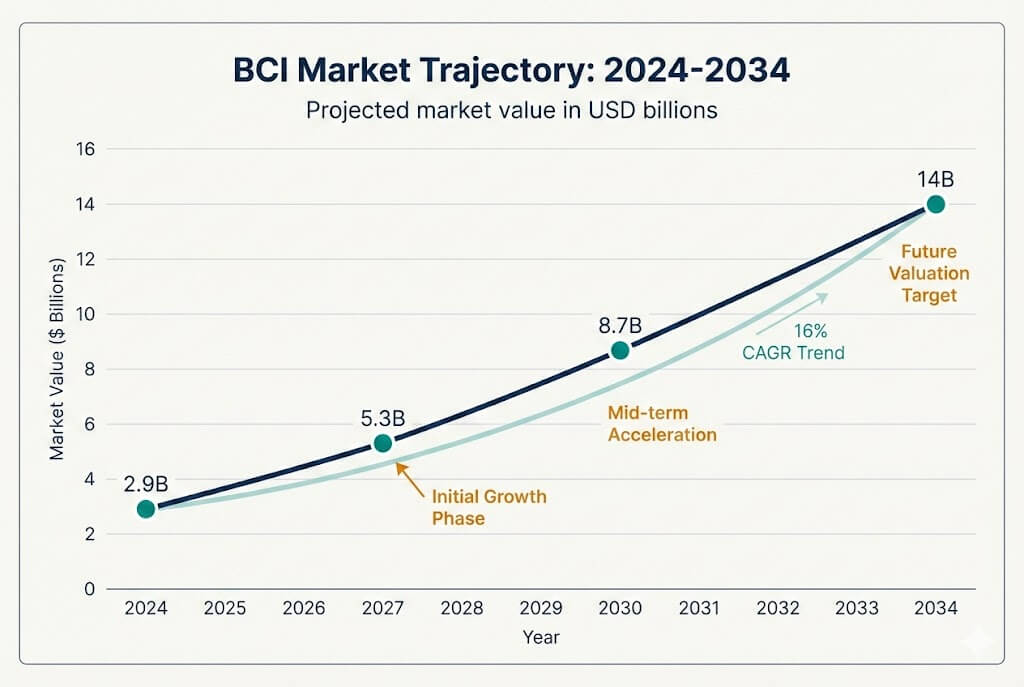
| Year | Market Value | Growth Driver |
|---|---|---|
| 2024 | $2.9 billion | Medical device approvals |
| 2027 | $5.3 billion | Enterprise pilot programs |
| 2030 | $8.7 billion | Consumer early adoption |
| 2034 | $13-15 billion | Mainstream integration |
Compound annual growth rate: 15-17%
Funding Trajectory
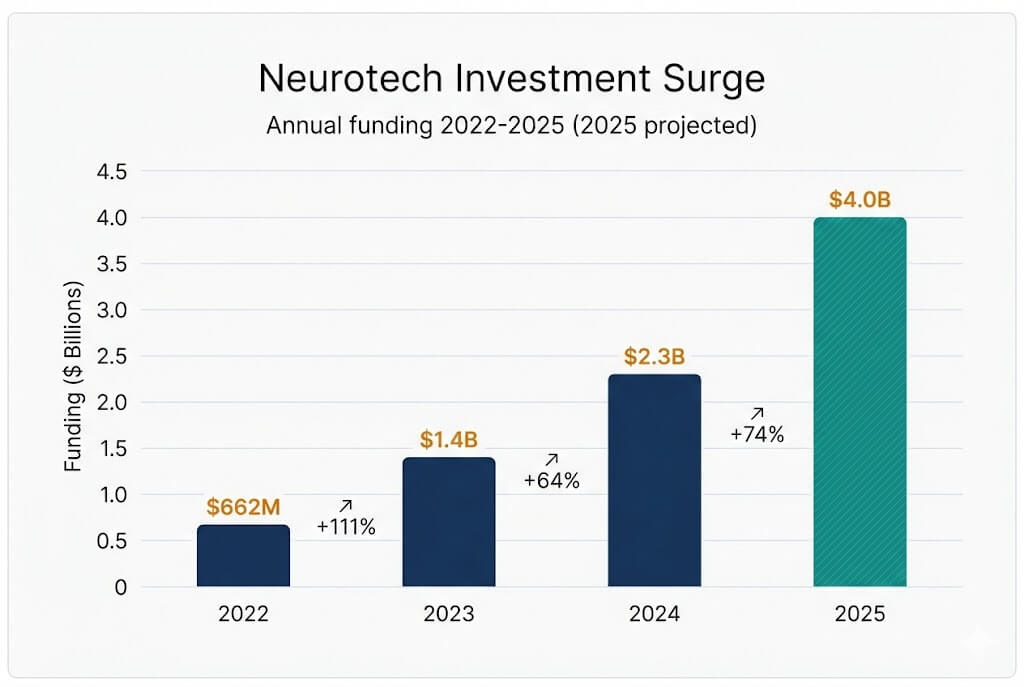
Key Investment Thesis
Smart capital is betting on:
- Regulatory pathways clearing faster than expected (FDA breakthrough device designations)
- Non-medical applications emerging sooner than consensus forecasts
- AI decoder improvements outpacing hardware limitations
- Neurorights frameworks creating barriers to entry for late movers
References
Primary Sources
1. Neuralink Corporation. (2025). *PRIME Study Clinical Updates*. Retrieved from public announcements and FDA filings.
2. Synchron, Inc. (2024). *COMMAND Trial Results: Safety and Efficacy of the Stentrode in ALS Patients*. Presented at American Academy of Neurology Annual Meeting.
3. U.S. Food and Drug Administration. (2024). *510(k) Clearance: Precision Neuroscience Layer 7 Cortical Interface*. FDA Device Database.
4. Paradromics, Inc. (2024). *Connexus Direct Data Interface Technical Specifications*. Company documentation.
5. Blackrock Neurotech. (2024). *MoveAgain BCI System: Long-term Performance Data*. Clinical research publications.
Regulatory and Legal Sources
6. Republic of Chile. (2021). *Constitutional Amendment on Neurorights*. Official Gazette.
7. Colorado General Assembly. (2024). *Colorado Privacy Act Amendments: Neural Data Protections*. Senate Bill 24-058.
8. California State Legislature. (2024). *California Consumer Privacy Act: Neurodata Provisions*. Assembly Bill 1008.
9. European Parliament. (2024). *Artificial Intelligence Act: Final Text*. Official Journal of the European Union.
10. Chile Consumer Protection Agency (SERNAC). (2023). *Resolution on Emotiv Neural Data Collection Practices*. Agency ruling.
Market Research
11. Grand View Research. (2024). *Brain Computer Interface Market Size, Share & Trends Analysis Report, 2024-2030*.
12. Precedence Research. (2024). *Neurotechnology Market Report: Global Industry Analysis*.
13. PitchBook. (2025). *Neurotech Venture Capital and Private Equity Report*.
Academic and Technical Literature
14. Willett, F., et al. (2023). *High-performance brain-to-text communication via handwriting*. Nature, 593, 249-254.
15. Moses, D., et al. (2021). *Neuroprosthesis for Decoding Speech in a Paralyzed Person with Anarthria*. New England Journal of Medicine, 385, 217-227.
16. Musk, E., & Neuralink. (2019). *An Integrated Brain-Machine Interface Platform With Thousands of Channels*. Journal of Medical Internet Research, 21(10).
17. Oxley, T., et al. (2021). *Motor neuroprosthesis implanted with neurointerventional surgery improves capacity for activities of daily living tasks in severe paralysis*. Journal of NeuroInterventional Surgery, 13, 102-108.
Industry Analysis
18. McKinsey & Company. (2024). *The Future of Brain-Computer Interfaces in Healthcare and Beyond*.
19. Deloitte Insights. (2024). *Neurotechnology and the Enterprise: Strategic Implications*.
20. MIT Technology Review. (2025). *10 Breakthrough Technologies: Brain-Computer Interfaces*.
Continue the Conversation
The BCI inflection point is not a distant future. It is unfolding now. If you are navigating AI strategy decisions or exploring neural interface implications for your enterprise, I would welcome the conversation.
Start a ConversationOr follow my work on LinkedIn
Author's Note
This article was written in collaboration with AI, reflecting the very theme it explores: the productive partnership between human intention and machine capability. The synthesis of research across multiple sources, the structuring of complex technical material, and the integration of strategic analysis all benefited from AI assistance.
This collaboration does not diminish the human elements of judgment, experience, and philosophical perspective. It amplifies them. Just as BCI promises to amplify human capability through direct neural connection, AI writing assistance amplifies human thought through computational partnership.
The question is not whether to collaborate with AI. The question is how to do so wisely.
Dave Senavirathne advises companies on strategic AI integration. His work bridges enterprise pragmatism with frontier research in consciousness and neurotechnology.