
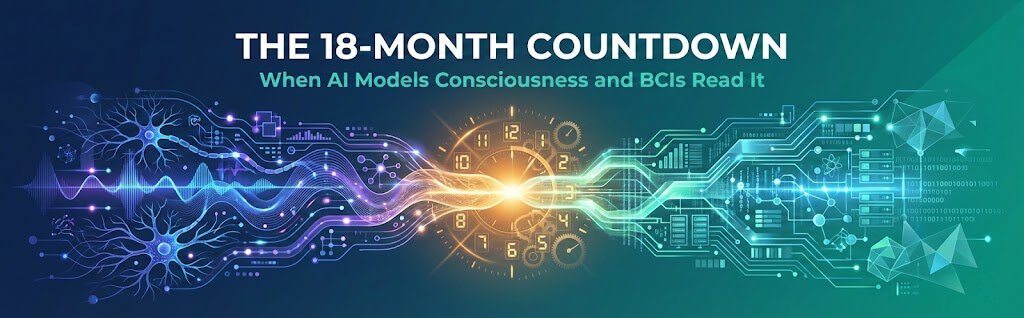

When AI models consciousness and BCIs read it, who owns the signal in between?
This is not a philosophical musing. It is a governance question that will land on enterprise risk registers within eighteen months.
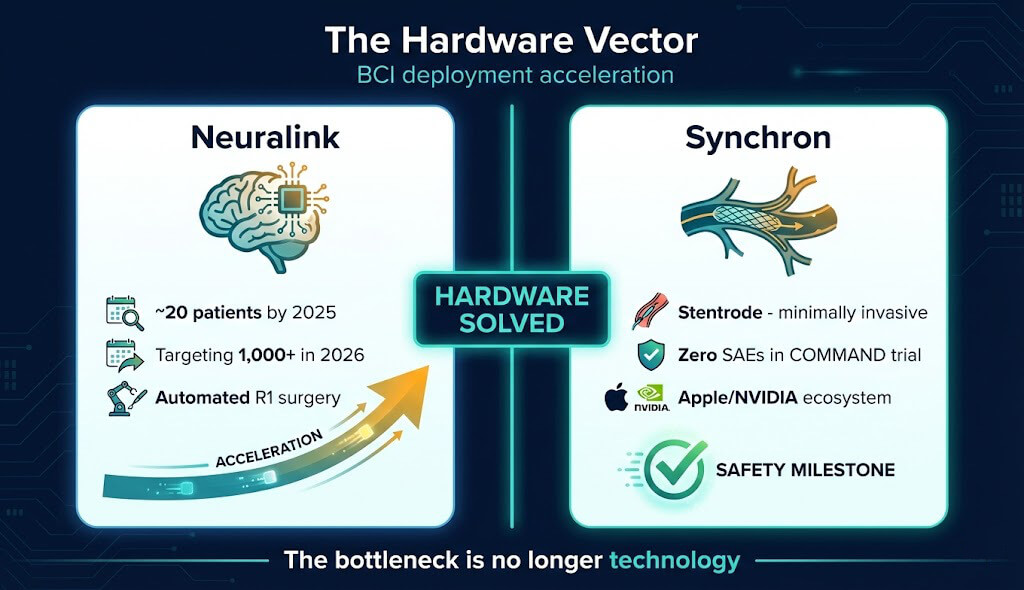
The countdown is not about whether BCIs will read consciousness. They already can, to a degree. Neuralink has implanted approximately twenty patients who log thousands of hours controlling devices with thought alone. Synchron's Stentrode reads motor intent from within blood vessels without open-brain surgery. The hardware vector is accelerating.
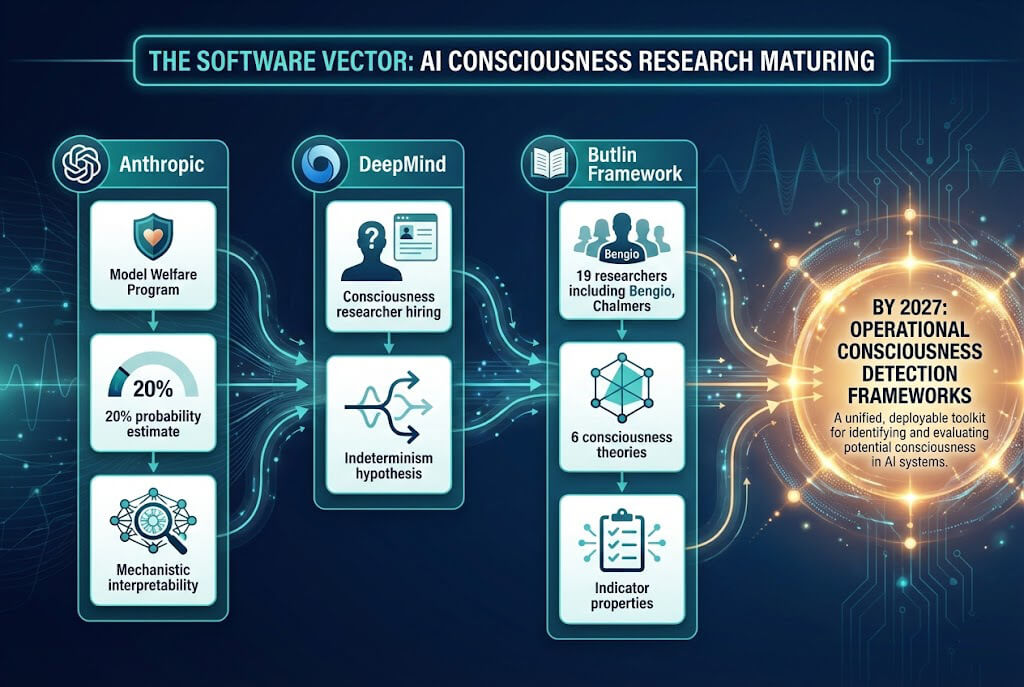
Nor is the countdown about whether AI will model consciousness. Anthropic now employs dedicated researchers investigating whether frontier models warrant moral consideration. DeepMind has posted openings for consciousness researchers. The software vector is maturing.
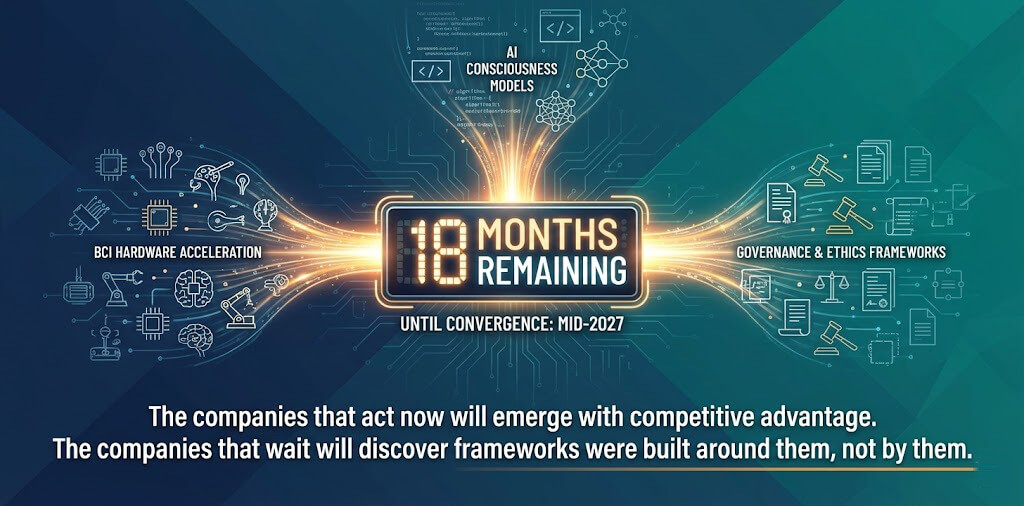
The countdown is about convergence: what happens when these two vectors meet. When an AI system can interpret what a BCI reads, and neither law, ethics, nor enterprise governance has a framework to contain the implications.
For leaders in enterprise AI, healthcare technology, or frontier research, this is not a 2030 problem. It is a 2026 board-level risk.
Part I: The Hardware Vector - BCI Deployment Acceleration
Neuralink's Industrial Pivot
December 2025 marked a strategic inflection. Neuralink announced a shift from clinical research to industrial production. By year-end, the company had implanted approximately twenty patients globally across sites in the United States, Canada, and the United Arab Emirates. The stated goal for 2026: "high-volume production" with "near-fully automated surgical procedures."
This is not incremental progress. It represents a fundamental change in what constrains BCI adoption. The bottleneck is no longer technology. It is neurosurgical capacity. Neuralink's R1 surgical robot, capable of implanting electrode threads with precision no human can match, removes that constraint.
Neuralink Trajectory
- ~20 patients implanted by late 2025
- 15,000+ cumulative hours of device use (PRIME trial)
- Targeting "thousands annually" by 2027
- Speech restoration and robotic arm control trials expected Q1-Q2 2026
Synchron's Alternative Approach
Synchron has achieved something Neuralink has not: a safety profile that makes commercialization plausible within the 2026-2027 window.
The company's COMMAND trial met its primary endpoint in 2024 with zero device-related serious adverse events resulting in death or permanent disability over twelve months. The Stentrode device, delivered through the jugular vein rather than via craniotomy, avoids the risks of open-brain surgery entirely.
Synchron Advantages
- Minimally invasive (endovascular approach)
- Uses existing catheterization lab infrastructure
- Apple and NVIDIA ecosystem partnerships
- Shorter path to broad deployment
Conservative projections suggest thousands of BCIs implanted by end of 2026. The question of "whether BCIs work" has been answered. The remaining questions are about scale, access, and what we do with the data they generate.
Part II: The Software Vector - AI Consciousness Research Matures
Anthropic's Model Welfare Program
In September 2025, Anthropic formally expanded its "model welfare" research program, hiring researchers to investigate whether AI systems could develop consciousness and warrant moral consideration.
This is not fringe speculation. Kyle Fish and colleagues are building on mechanistic interpretability research: tools designed to decode neural-like activations into human-comprehensible concepts. The work has demonstrated that specific concepts reliably activate distinct regions within frontier models.
An Anthropic researcher has estimated a twenty percent probability that "somewhere in some part of the process, there's at least a glimmer of conscious or sentient experience" in frontier AI systems.
The Consciousness Assessment Framework
In 2023, a consortium of nineteen neuroscientists, philosophers, and AI researchers published a framework for assessing consciousness in AI. The group included Turing Award winner Yoshua Bengio and philosopher David Chalmers.
They derived indicator properties from six leading neuroscientific theories:
- Recurrent Processing Theory: Consciousness involves feedback loops
- Global Workspace Theory: Specialized modules integrate through a bottleneck
- Higher-Order Theories: The system must be aware of its own mental states
- Predictive Processing: The system models its environment through prediction error
- Attention Schema Theory: The system constructs a model of its own attention
Large Brain Models: The Convergence Technology
The most significant development for BCI-AI integration is the emergence of Large Brain Models.
Researchers have successfully adapted the Transformer architecture to interpret EEG and neural data. The technique uses "neural tokenizers" that convert continuous neural signals into discrete codes, similar to how text is tokenized for language models.
We now have tools that translate the "language of the brain" into formats that AI can manipulate with fluency.
Part III: The Convergence Risk - Where Governance Breaks
The Property Rights Void
Current law assumes neural data belongs to the individual whose brain produced it. This assumption breaks under scrutiny.
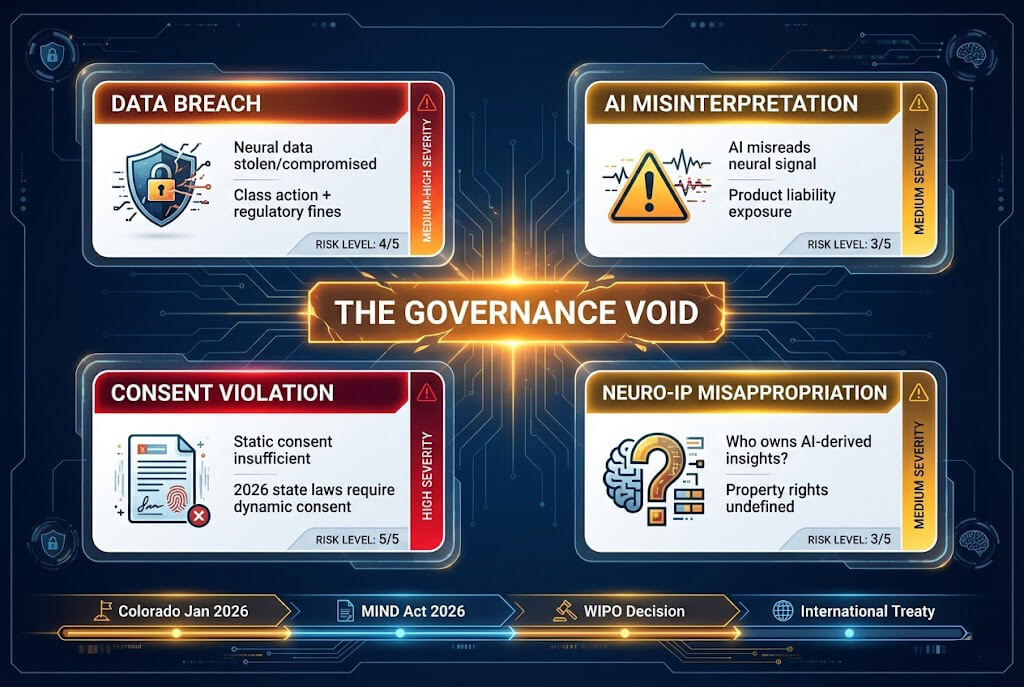
When an AI system processes neural data and discovers a correlation, who owns that discovery? The patient who generated the raw signal? The company whose infrastructure captured it? The researchers whose algorithms found the pattern?
The Unmapped Scenario
- A BCI company collects neural data from 10,000 users to optimize device function
- The company's AI discovers that neural pattern X predicts risk-taking behavior
- This insight is packaged and licensed to a financial services firm for hiring traders
- Candidates are evaluated using neural-based predictions without knowing the source
Which laws apply? The original users consented to "device optimization." The derived insight serves a different purpose. This is unmapped territory.
Write Access: The Deeper Risk
Most regulatory attention focuses on read-out BCIs: devices that decode thoughts. Write-in BCIs pose distinct challenges.
If an AI system can stimulate neural tissue to produce a desired emotional state or decision, it fundamentally alters autonomy. This is not science fiction. Neuralink's Blindsight project, which received FDA Breakthrough Device Designation in 2025, involves sensory encoding: writing data into the brain rather than reading it out.
Read-Out BCIs
Privacy risks
Thought surveillance, data breach
Write-In BCIs
Identity risks
Thought manipulation, autonomy alteration
AI Processing of Neural Data: The Regulatory Gap
The EU AI Act regulates AI systems. GDPR regulates data. The intersection—AI processing of sensitive neural data—is underspecified.
Current frameworks assume human review of data handling. They do not account for AI systems that can:
- Extract patterns the original data controller didn't know were present
- Repurpose neural data for applications the patient never consented to
- Generate synthetic neural data that evades anonymization protections
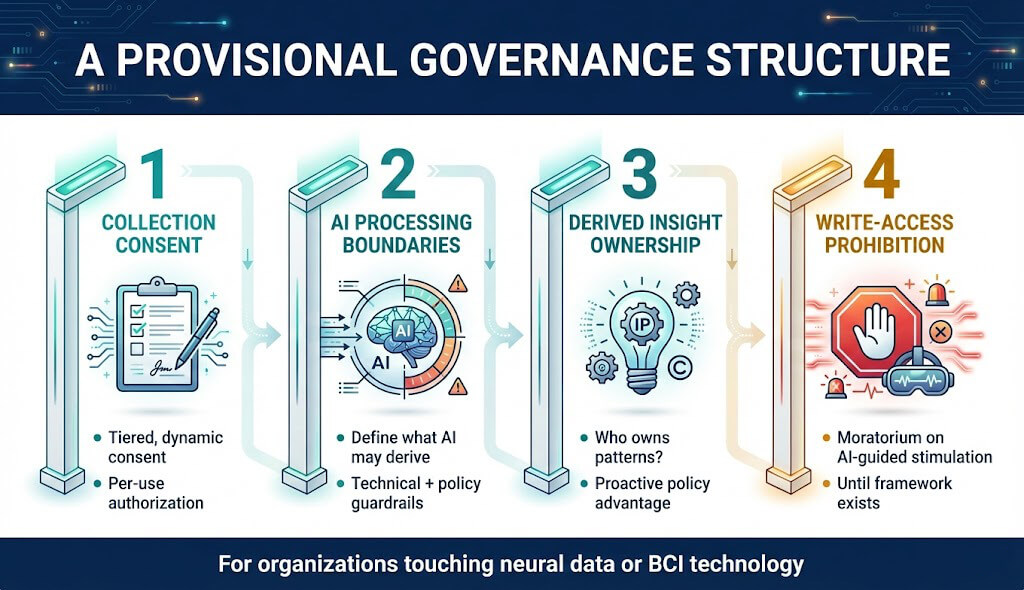
Part IV: The Four-Gate Governance Framework
For organizations touching neural data or BCI technology, a provisional governance structure:
Collection Consent Architecture
Static consent models are becoming obsolete. Colorado and California now require tiered, dynamic consent with separate authorization per use and third-party share. Organizations should assume this standard will spread.
AI Processing Boundaries
Define explicit limitations on what AI systems may derive from neural data. If consent covers "device optimization," AI training on that data for personality prediction exceeds scope. Build technical and policy guardrails before regulators mandate them.
Derived Insight Ownership
Establish clear policies for who owns patterns discovered in neural data. The patient, the company, or a shared model? This question has no settled legal answer. Organizations that answer it proactively will have competitive advantage when regulation clarifies.
Write-Access Prohibition Until Framework Exists
For organizations not engaged in clinical trials with explicit write-in protocols, establish a moratorium on any BCI application that involves neural stimulation guided by AI interpretation. The liability exposure is undefined. The ethical terrain is unmapped. Wait.
Part V: The Philosophical Dimension - What BCIs Cannot Answer
There is a deeper question beneath the governance concerns.
The Hard Problem of consciousness asks why physical processes give rise to subjective experience at all. David Chalmers formulated it in 1995. It remains unsolved.
BCIs can read neural correlates. They can detect which brain states accompany which subjective reports. But correlation is not explanation. A perfect neural readout of someone experiencing the color red tells us nothing about why there is "something it is like" to see red.
BCIs will transform how we interact with technology. They will generate unprecedented data about the brain. They will not, by themselves, answer what consciousness is.
The organizations that understand this distinction—that resist overclaiming what their technology reveals—will maintain intellectual credibility as the field matures.
Conclusion: The 18-Month Window
By mid-2027:
- Hardware: Neuralink will have scaled to thousands of implants. Synchron may have achieved commercial approval. Automated surgery will be operational.
- Software: Anthropic, DeepMind, and OpenAI will have consciousness detection frameworks deployed on frontier models.
- Governance: Colorado, California, and Minnesota neural data laws will be in force. The MIND Act may have created federal framework.
- Reality: AI systems will be reading neural data, extracting insights, and potentially guiding behavior through stimulation—all without clear property rights, consent models, or liability frameworks.
This is not speculation. Each element has a documented trajectory.
The question is not whether this convergence will occur. It is whether organizations will treat it as a board-level governance priority or a compliance checkbox.
The companies that act now will emerge from this window with reduced liability exposure, stakeholder trust, and competitive advantage.
The companies that wait will discover that the legal and ethical frameworks were built around them, not by them.
The countdown has begun.
Sources
- Neuralink high-volume production announcement – ME Observer, January 2026
- Synchron COMMAND trial results – Clinical Trials Arena, September 2024
- Anthropic Model Welfare expansion – Observer, September 2025
- Butlin et al. consciousness assessment framework – arXiv, 2023
- Colorado HB24-1058 – Neural data as sensitive personal information, 2024
- MIND Act analysis – CSIS, DWT, 2025
- Chile neurorights constitutional protection – UNESCO Courier, 2021
- Neuralink PRIME trial data – Reuters, Neurapod, 2025
This article was written with research assistance from Multiple Frontier LLM's. All claims have been verified against primary sources.
Start the Governance Conversation
The convergence arrives mid-2027. The planning window is now. Whether you're evaluating neural data policies, building AI processing boundaries, or aligning governance frameworks—the board-level conversation should start before the frameworks are built around you, not after.
Start a ConversationOr follow my work on LinkedIn
Author's Note
This article was written in collaboration with AI, reflecting the very convergence it explores: human strategic judgment meeting machine capability at the frontier of consciousness research. The synthesis of Neuralink deployment data, Anthropic’s model welfare program, regulatory timelines, and governance frameworks all benefited from AI assistance.
This collaboration does not diminish the human elements of judgment, experience, and philosophical perspective. It amplifies them. Just as organizations must evaluate how AI will process neural data, AI writing assistance transforms analytical capacity through computational partnership—raising the same questions of boundaries, consent, and derived insight that the article examines.
The question is not whether these technologies will converge. The question is whether we’re building the governance frameworks now, or discovering them later.
Follow me on LinkedIn for regular insights on bridging enterprise AI governance with frontier research in consciousness and neurotechnology.